Voice recorders for homeowners and small businesses: how background noise ruins evidence recordings
Voice recorders are common tools for homeowners, small business owners, and professionals, but background noise can render otherwise usable recordings inadmissible or meaningless as evidence. This article explains how ambient noise, recording settings, and device choice interact with laws and forensic standards, and provides concrete comparisons, use cases, and selection logic to help you avoid critical mistakes.
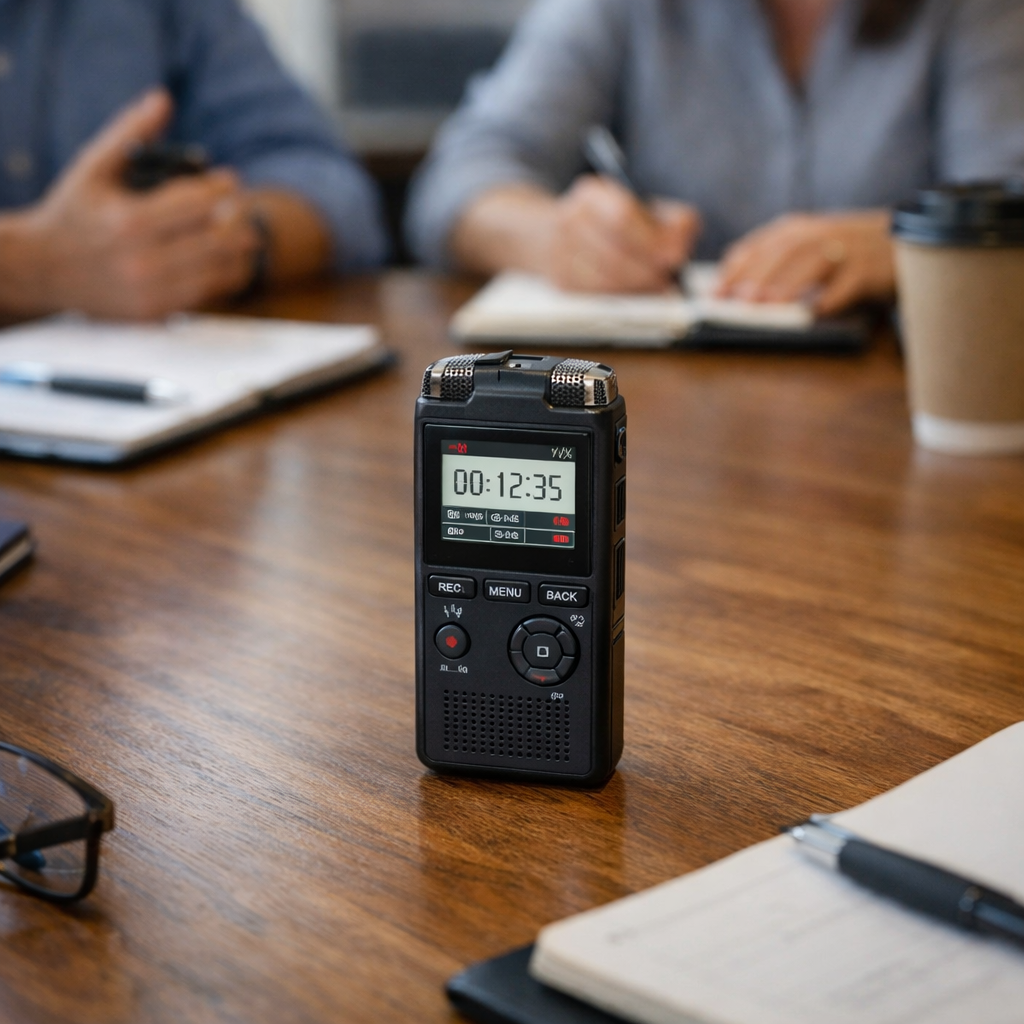
How background noise affects voice recorders and evidentiary value
Background noise reduces intelligibility and can alter the perceived context of a recording. In legal or compliance contexts that depend on voice recorders, degraded audio can prevent identification of speakers, obscure timestamps or verbal agreements, and make a recording vulnerable to challenge during admissibility review. Forensic analysts assess signal-to-noise ratio, compression artifacts from a digital voice recorder, and any edits that might suggest tampering. Poor recordings can therefore fail at two levels: technical unreliability and legal credibility.
Types of background noise and their specific impacts on voice recorders
Not all noise has the same effect. Continuous low-frequency hums from HVAC systems mask consonants, intermittent high-frequency noises like alarms can trigger voice activated recorder gaps, and overlapping speech confounds speaker separation algorithms. Transient noises (door slams, sirens) create clipping or sudden gain changes that may erase nearby speech. Understanding noise characteristics helps you plan mitigation and choose devices that handle expected environments.
Comparison: device types and vulnerability to background noise
Different recorder styles offer distinct strengths and weaknesses when background noise is present. A mono digital voice recorder with built-in omnidirectional mic captures everything equally and is most vulnerable in busy environments. Directional recorders and external shotgun microphones reduce off-axis noise but require alignment. Smartphone apps and low-cost voice recorders often apply heavy compression that amplifies noise artifacts, while higher-end digital voice recorder models provide better preamps, variable bitrates, and multi-mic arrays that improve intelligibility.
Pros and cons by scenario
- Home meetings or disputes: Compact voice recorders are easy to deploy but suffer from room reverberation. Use close placement and a model with noise reduction filters.
- Retail or reception areas: Directional microphones or boundary mics reduce crowd noise but may be conspicuous and raise privacy issues.
- Outdoor surveillance: Wind and traffic demand windshields and higher sampling rates; low-quality devices will mask low-volume speech.
Use cases and decision logic: when noise ruins evidence
Consider three practical scenarios to show how background noise changes decisions:
1. Witness statement recorded at home
A homeowner records a neighbor admitting responsibility during a backyard conversation. If traffic noise or a barking dog masks key words, the recording may not establish intent. Decision logic: if the expected SNR (signal-to-noise ratio) is low, either relocate, use multiple recorders, or supplement with contemporaneous notes to preserve evidentiary value. Read the complete Voice Recorders guide
2. Employee meeting in an open-plan office
Human resources saves a meeting using a voice activated recorder. The device’s activation threshold may cut out quiet admissions or clip speech during pauses, and competing conversations will reduce speaker identification confidence. Decision logic: disable voice activation for legal recordings, use omnidirectional array microphones to capture all participants, and log meeting time and attendees separately. Browse Voice Recorders
3. After-hours shop surveillance
A small business owner uses a digital voice recorder to capture theft. Background HVAC hum and distant street noise lower clarity and may prevent distinguishing voices. Decision logic: place recorder near likely interaction points, use a recorder with variable bitrate and low-noise preamps, and consider combining audio with timestamped video if legally permissible.
Choosing voice recorders to minimize background noise
Selecting the right device requires matching environment, legal purpose, and technical specs. Key criteria include microphone type, sample rate and bitrate, storage format, gain control, and whether the unit uses voice activation. Evaluate noise reduction and filtering features, the availability of external mic inputs, and battery reliability. For evidentiary use, prefer recorders that support lossless or high-bitrate WAV files to avoid compression artifacts that complicate forensic analysis.
Essential specifications explained
- Microphone pattern: Directional (cardioid) mics reject off-axis noise; omnidirectional mics capture room ambience which can be helpful for context but harmful for clarity.
- Sample rate and bitrate: Higher sample rates (44.1–96 kHz) and bitrates reduce quantization noise and preserve speech nuances important for identification.
- Preamp quality: Low-noise preamps improve the baseline signal so weak voices remain intelligible.
- Voice activation: Voice activated recorders save space but risk missing low-volume speech and creating spliced files that look edited.
Practical examples and common mistakes
Real-world mistakes repeat: placing a recorder on a crowded table, relying on voice activation in noisy settings, ignoring microphone orientation, and trusting consumer-grade compression for evidence. For example, a property manager recorded a tenant dispute with a phone app; traffic noise and aggressive compression left only fragments of key admissions, and opposing counsel argued the recording was unreliable. Corrective actions include testing before critical recordings, making simultaneous backup recordings with a second device, and using directional mics or external lapel mics when privacy and law permit.
Another example: a small law firm used a handheld digital voice recorder to capture client interviews in a busy waiting room. The recorder’s automatic gain control pumped gain during quiet segments, amplifying hiss and making speaker identification ambiguous. A better approach would have been manual gain control, use of a noise floor test, or moving to a private room with a recorder set to linear PCM.
Legal and ethical considerations (EU and US high-level)
Recording laws differ across jurisdictions and affect admissibility and legality. In many US states one-party consent suffices for audio capture, while several states require all-party consent. EU rules emphasize data protection and lawful processing under GDPR; recordings that identify individuals may be considered personal data and require lawful basis and retention limits. Beyond statutory law, evidentiary standards in courts demand authenticity and chain-of-custody. Label settings, time stamps, and unedited files improve credibility. Always document your purpose and storage practices to show compliance and minimize privacy risk. Discreet solutions
Ethically, avoid surreptitious recordings where individuals have a reasonable expectation of privacy (bathrooms, changing rooms) and consider proportionality when capturing conversations in semi-public spaces. When in doubt, seek targeted legal advice before relying on a recording as evidence.
Buyer guide: evaluating recorders to survive scrutiny
When buying for evidentiary use, follow a simple checklist: choose a device with uncompressed recording modes, manual gain control, external mic input, and clear metadata. Test devices in the real environment before relying on them, and verify battery life and file integrity under repeated use. Avoid voice activated recorder modes for legal recordings unless you have confirmed they capture critical intervals reliably. Balance concealment needs with legal transparency: hidden devices may be unlawful in some contexts.
Common selection mistakes
- Prioritizing price over preamp and mic quality.
- Assuming voice activation never fails—do controlled tests.
- Trusting smartphone apps without verifying bitrate and file format.
- Neglecting storage redundancy and secure file transfer procedures.
Frequently Asked Questions
Q: Will a voice activated recorder save disk space without risking evidence loss?
A: Voice activation reduces file size but can miss quiet speech and create disjointed files that look edited; avoid it for legal recordings unless tested and documented.
Q: Can background noise be removed later by software?
A: Noise reduction can improve clarity but may introduce artifacts and is scrutinized in court; preserve original files and document any processing.
Q: Is a digital voice recorder always better than a smartphone?
A: Not always. High-quality digital voice recorders often have superior preamps and formats, but some smartphones with external mics can match quality; test both in the expected environment.
Q: How should I store recordings to maintain admissibility?
A: Keep original unedited files, secure backups, and logs of capture time and chain-of-custody. Use non-proprietary formats like WAV for primary evidence.
Q: Are hidden recorders admissible in court?
A: Admissibility depends on state and national laws and privacy expectations; hidden recordings often raise legal and ethical issues—consult jurisdictional guidance before use.
Educational closing
Background noise is not merely an annoyance; it actively degrades the forensic and legal value of recordings made with voice recorders. Understanding noise types, device trade-offs, and legal boundaries allows homeowners, small business owners, and professionals to make decisions that protect evidentiary integrity. Test devices in situ, document procedures, prefer uncompressed formats, and weigh ethical and jurisdictional constraints before relying on any recording as evidence.