Voice Recorders for Meetings vs Surveillance: Legal and Practical Use Cases
Choosing the right voice recorders for a specific purpose requires parsing legal boundaries, technical requirements, and practical trade-offs. Whether you need a device for documented meeting minutes, client interviews, or covert surveillance, the device class and operating procedures determine compliance risk and evidentiary value. This article compares meeting-focused recorders and surveillance setups, offers decision logic for homeowners and small businesses, and highlights common mistakes to avoid. Read the complete Voice Recorders guide
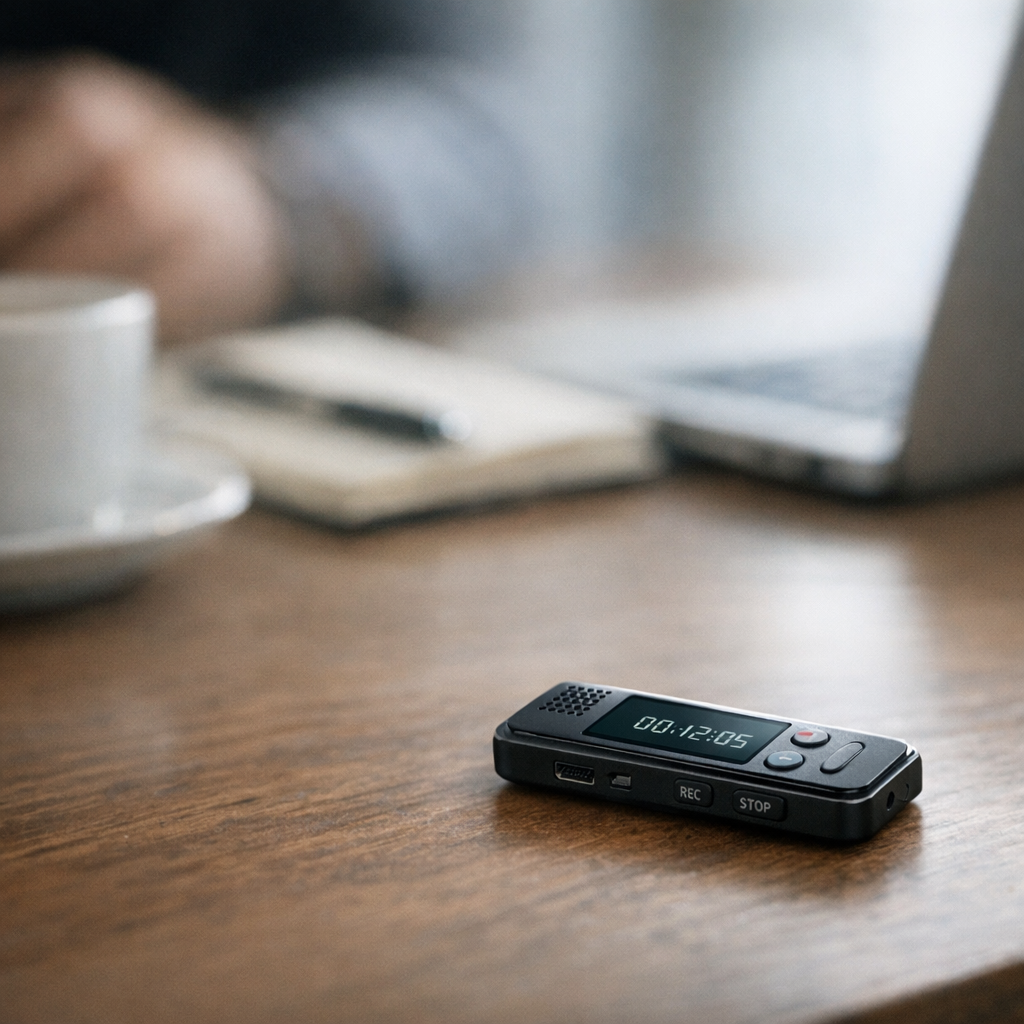
Voice recorders in meetings: legal expectations and operational setup
Meeting use typically assumes consent, notice, or institutional policy that permits audio capture. In workplaces, boards, client calls, or contractor briefings, a voice recorder or digital voice recorder is used openly to capture accurate notes, timestamps, and speaker identification. The key compliance tasks are clear: inform attendees, document consent where required, and secure recordings under data-retention policies.
Operationally, meeting recorders prioritize clarity, battery life, and transcription-friendly formats. Portable digital voice recorders with omnidirectional microphones are common; voice activated recorder features can reduce file size by trimming silence, but they can also drop low-volume remarks. For formal contexts consider higher sample rates, timestamping, and encrypted storage to meet privacy and retention obligations.
Voice recorders for surveillance: constraints, risks, and detection trade-offs
Surveillance recording—covert capture of conversations—carries elevated legal and ethical risk. In many jurisdictions, recording without all-party consent is illegal or admissibility-limited. Surveillance scenarios demand discretion, small form factors, and different audio engineering: focused microphones, gain control, and noise-reduction. A voice activated recorder can extend run-time, but activation thresholds must be tuned to avoid losing critical utterances.
From a risk perspective, surveillance-grade recorders increase exposure to civil claims, employment disputes, and regulatory penalties if misused. Small businesses and homeowners weighing surveillance should document legitimate reason, preserve minimal data, and consult high-level compliance guidance before deployment. Technical anonymity (discreet digital voice recorders) does not equal legal immunity.
Comparison: meetings vs surveillance — structured pros and cons
Comparing the two use cases helps select hardware and processes. Meeting recording emphasizes transparency and evidence quality; surveillance emphasizes discretion and reach. The table below summarises key contrasts to weigh when buying or operating a device.
Meeting recording — typical advantages
- Legal clarity when consent or policy is present.
- Higher audio quality for transcription and legal records.
- Simple workflows for storage and access control.
Meeting recording — typical disadvantages
- Limited usefulness in hostile or private spaces without consent.
- Open devices may change participant behavior.
Surveillance recording — typical advantages
- Can capture unguarded statements in investigations or security incidents.
- Small devices increase deployment flexibility.
Surveillance recording — typical disadvantages
- High legal risk where one-party or all-party consent laws apply.
- Lower audio quality at distance and higher false negatives with voice activation.
- Evidence may be excluded or create liability.
Decision logic: choosing between meeting and surveillance recorders
Decide using a simple flow: define purpose → map to legal context → list technical needs → choose device and policies. For example, if your purpose is to keep minutes for a contractor meeting, prefer a visible digital voice recorder with clear notice and encrypted storage. If your objective is to investigate suspected theft at a retail counter, analyze statutory consent and consider video with audio only after confirming legality and proportionality. Browse Voice Recorders
Key technical filters include microphone type (omnidirectional vs shotgun), storage format (wav vs compressed mp3), power profile, and voice-activation reliability. In meeting rooms, omnidirectional mics and higher sample rates improve speaker separation; in surveillance, directional mics and gain control reduce background noise.
Buyer guide: evaluation criteria and selection checklist
When evaluating models, rate them against compliance, audio quality, concealability, runtime, and data security. A practical checklist for buyers:
- Legal suitability: Will operation comply with local consent laws?
- Audio fidelity: Does the device record at sufficient bitrate for transcription or forensic use?
- Activation and recording mode: Is a voice activated recorder mode available and configurable?
- Storage & encryption: Can files be password-protected or encrypted to protect subjects’ privacy?
- Physical form factor: Is the device appropriate for open or covert use without encouraging misuse?
- Battery and fail-safes: Is there long runtime or external power options for long meetings or stakeouts?
- Chain of custody: Does the workflow enable defensible preservation of audio?
For many team leaders, a mid-range digital voice recorder meets meeting needs while minimizing unnecessary risk. For surveillance, specialized equipment and legal counsel are often warranted; covert gear designed for field investigators differs significantly from off-the-shelf meeting recorders.
Practical examples and common mistakes
Example 1 — Board meeting minutes: A small business uses an upright digital voice recorder, announces recording in the agenda, stores files on encrypted cloud storage, and retains recordings for 90 days. This process minimizes legal exposure and preserves accurate minutes.
Example 2 — Incident investigation: A store manager suspects internal theft and places a concealed recorder behind a shelf without informing staff. If local law requires all-party consent, this can trigger litigation and evidence exclusion. A safer route is to install visible signage, use CCTV with audio where permitted, or obtain legal advice before covert recording.
Common mistake: relying on a voice activated recorder mode without testing in the target environment. Background HVAC noise, distance, or speech patterns can inhibit activation and produce gaps. Always test settings in situ and prefer continuous recording for critical meetings or when evidence continuity matters.
Common mistake: neglecting data management. Retaining long-term audio without purpose increases privacy risk and regulatory scrutiny. Adopt minimal retention schedules and role-based access for recorded files.
Legal & ethical considerations (EU and US high-level)
High-level guidance: laws vary. In the United States, federal law allows one-party consent for recordings in many contexts, but some states require all-party consent — and workplace or commercial regulations may impose additional constraints. In the EU, the GDPR treats recorded conversations as personal data: lawful basis, purpose limitation, transparent processing, and data minimization apply. Documenting lawful basis and publishing retention rules reduces compliance risk.
Ethically, consider proportionality and necessity. Covert surveillance should be a last resort, proportional to the risk being addressed, and accompanied by internal approvals. For employee monitoring, follow labor and privacy rules and maintain transparent policies where legally required. Technical anonymity does not eliminate ethical duties.
Frequently Asked Questions
Q: Is it legal to record a meeting without telling participants?
A: Legality depends on jurisdiction and context; many places allow one-party consent, but explicit notice or policy is safest for workplace meetings.
Q: Do voice activated recorders miss important parts of conversations?
A: They can if activation thresholds are poorly configured or speakers are distant; test in the actual environment before relying on them.
Q: Can a digital voice recorder be used as court evidence?
A: Admissibility depends on chain-of-custody, authenticity, and local recording laws; lawful collection and proper preservation improve evidentiary value.
Q: How long should I retain recorded meetings?
A: Retention should match business need and legal requirements; commonly 30–90 days for routine meetings, longer for contractual or dispute-related records, with access controls.
Q: Are small concealed recorders always illegal in private homes?
A: Not always—laws differ and context matters (for example, recording your own private conversations is different from recording guests). Verify consent rules and privacy implications before deploying covert devices.
Educational closing
Selecting and operating voice recorders requires aligning technical choices with legal and ethical frameworks. For meetings, prioritize transparency, quality, and secure retention. For surveillance, treat covert recording as high-risk: verify legal authority, limit scope, and document necessity. Use the decision logic and buyer checklist provided here to match device capabilities—whether a basic voice recorder, a voice activated recorder, or a specialized digital voice recorder—to your real-world needs while minimizing legal exposure and preserving trust. Discreet solutions