Voice Recorders for Homeowners and Small Businesses: Why Cheap Microphones Create Unusable Evidence
Choosing voice recorders for home or small business use is not only a matter of storage and runtime: microphone quality directly determines whether a recording is intelligible, admissible, and legally useful. This article explains how cheap microphones change real recording outcomes, outlines practical selection criteria, and highlights common mistakes owners and managers make when they treat every recorder as interchangeable.
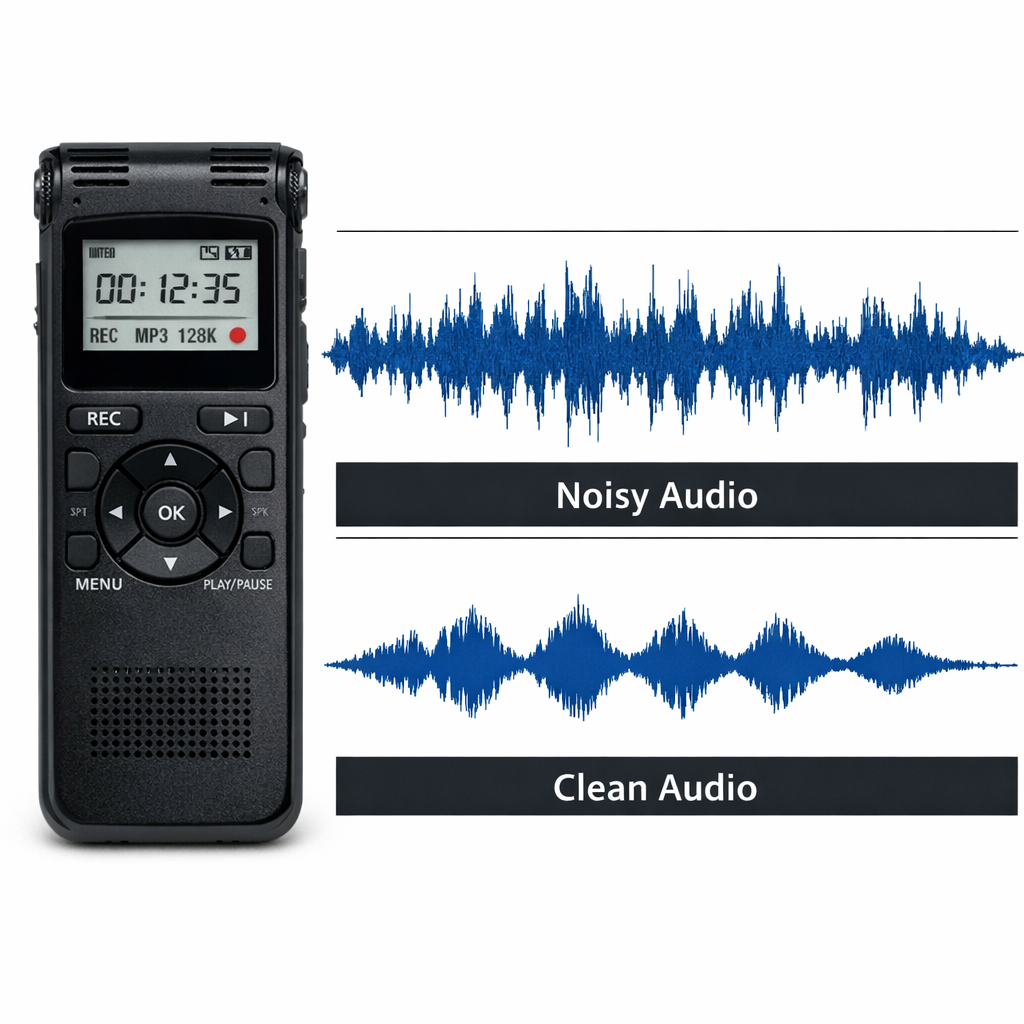
How voice recorders affect real recording outcomes and evidence quality
Microphone design and placement in voice recorders shape the signal-to-noise ratio, frequency response, and distortion characteristics that listeners and forensic analysts evaluate. A recorder with a low-quality electret capsule or poor preamplifier can smear consonants, shorten high-frequency extension, and add hiss—all factors that reduce intelligibility and confidence in audio evidence. In everyday terms, that means statements that sounded clear at the time of capture can become unintelligible under playback or spectral analysis.
Low-cost devices often sacrifice internal shielding, use cheap analog-to-digital converters, and omit limiting or gain control. These choices create clipping on loud sounds and buried speech on quiet ones. For homeowners recording a dispute or small businesses logging customer interactions, the result is the same: a reduction in recording clarity that can undermine the recording’s usefulness for insurance claims, HR investigations, or police reports.
Why microphone quality matters: technical comparison and consequences
Across a few objective metrics, microphone quality alters recording outcomes in predictable ways:
- Signal-to-noise ratio (SNR): Higher SNR reduces background hiss and makes speech more legible. Cheap microphones rarely exceed 60–65 dB SNR, while mid-range units often deliver 75 dB or more.
- Frequency response: Accurate reproduction of 2–8 kHz frequencies is critical for consonant clarity. Narrow, rolled-off responses can remove intelligible cues.
- Dynamic handling: A good microphone and preamp manage loud and quiet passages without clipping or compressing; cheap devices clip quickly, creating distortion that human ears and speech-recognition software struggle with.
- Directionality: Omnidirectional capsules record ambient noise; tuned cardioid or hypercardioid elements reduce off-axis noise in noisy environments.
Practically, those technical differences map to observable outcomes: recordings with poor SNR and limited frequency response are harder to transcribe, frequently rejected by forensic labs, and less persuasive to adjudicators. When audio evidence is central to a dispute, relying on a cheap recorder can mean losing a critical piece of proof.
Comparative table in narrative form: cheap vs. mid-tier vs. professional
Cheap consumer recorders: low-cost capsules, limited shielding, fixed gain—good for casual memos but risky for evidentiary capture. Mid-tier units: improved capsules, better preamps, selectable gain—suitable for business logs, interviews, and small-scale investigations. Professional field recorders: high SNR, interchangeable capsules, advanced filters, and locking gain—appropriate when chain-of-evidence and forensic clarity matter.
Choosing voice recorders: comparison, buyer criteria, and selection logic
Selection should be driven by intended use-case, not price alone. For routine home monitoring where conversations are incidental and context is informal, a mid-range recorder may suffice. For HR interviews, depositions, or evidence expected to support legal claims, choose devices that prioritize microphone quality, robust file formats (lossless or high-bit-rate codecs), and clear documentation of settings.
Key buyer criteria:
- Microphone capsule type: Electret omnidirectional for general capture; pressure-gradient or shotgun for focused capture in noisy rooms.
- Preamp and A/D quality: Look for spec sheets listing THD+N and SNR; lower distortion and higher SNR correlate with usable evidence.
- Gain control: Adjustable input gain or AGC with limiter avoids clipping while maintaining audibility.
- File format and bitrate: WAV or FLAC at 16-bit/44.1–48kHz or higher preserves forensic detail better than low-bitrate MP3.
- Physical placement and mounts: Consider how the recorder will be positioned—desk mounts, lapel holders, or wall enclosures affect recorded levels and noise.
When comparing models, test them in the actual environment where they will be used: a quiet living room, a busy storefront, or a reverberant office will each reveal different weaknesses. Document your test procedure and results; that documentation itself strengthens the credibility of a recording later on. Browse Voice Recorders
Pros and cons by scenario
Homeowner recording a domestic incident: pros of mid-tier devices include better intelligibility and longer battery life; cons include higher cost and need for deliberate placement. Small retail business recording customer interactions: pros of directional capsules and selectable bitrates; cons include privacy obligations and potential legal notice requirements. Investigator capturing statements for litigation: pros of professional gear with calibration and chain-of-custody practices; cons include training and expense.
Practical examples and common mistakes
Example 1 — A homeowner buys the cheapest voice recorders to document recurring noise from a neighbor. Recordings are full of compressor pumping and high-frequency roll-off, making dialog unintelligible. Consequence: insurer deems the audio inconclusive. Corrective action: test mid-tier units with real-world mock conversations placed at likely distances.
Example 2 — A small business uses a single omnidirectional recorder on the counter to capture complaints. Background HVAC noise buries the customer’s voice. Consequence: transcription is poor and dispute resolution stalls. Corrective action: choose a directional microphone or install multiple recorders with separate tracks for redundancy.
Common mistakes:
- Assuming recorded volume equals clarity—loud but clipped audio is unusable.
- Relying on automatic gain without testing in noisy environments—AGC can pump noise and bury speech.
- Using compressed low-bitrate formats for legal purposes—lossy codecs remove spectral cues needed for speaker identification.
- Not documenting device settings and chain of custody when recordings may enter a legal process.
In training and selection, simulate the real recording scenario multiple times and compare transcripts and spectral views across candidate devices. That differential testing identifies when a cheaper microphone is a false economy. Read the complete Voice Recorders guide
Legal and ethical considerations (EU and US high-level guidance)
Recording laws differ between jurisdictions. In the United States, many states permit one-party consent, meaning a single participant in the conversation may lawfully record; others require all-party consent. In the European Union, data protection rules under the GDPR apply to personal data captured in recordings, with stricter rules for purpose limitation, retention, and access. In both regions, poorly documented or surreptitious recordings with unclear provenance can be excluded in legal proceedings or trigger administrative penalties.
Best practices to reduce legal risk: notify participants when appropriate, minimize collection to relevant content, retain original files with metadata intact, and keep a written log of capture conditions. Avoid modifying or enhancing recordings in a way that obscures their origin; if enhancements are necessary for intelligibility, document the exact processing steps. These measures do not constitute legal advice but provide a practical compliance framework. Discreet solutions
Frequently Asked Questions
Q: Can I rely on low-cost voice recorders for court evidence? A: Generally no; low-cost microphones often lack the fidelity and documentation required to meet evidentiary standards.
Q: Does higher bitrate always mean better recording clarity? A: Higher bitrate preserves more detail, but clarity also depends on the microphone capsule, preamp, and placement.
Q: Is omnidirectional or directional microphone better for small businesses? A: Directional capsules are usually better in noisy environments because they focus on the speaker and reduce ambient noise.
Q: How should I store original recordings for potential legal use? A: Keep the original files unaltered, maintain metadata, and record a chain-of-custody log describing who handled the files and when.
Q: Are smartphone voice notes acceptable substitutes for dedicated voice recorders? A: Smartphones can be acceptable in informal contexts, but built-in mics, automatic processing, and compression often make them inferior to dedicated devices for evidentiary capture.
Educational closing
Microphone quality is the critical variable that separates useful recordings from unusable noise. For homeowners and small businesses, the right choice balances capsule quality, preamplifier performance, file format, and tested placement against legal and privacy obligations. Avoid the false economy of the cheapest device: invest time in side-by-side testing in your real environment, document settings and custody, and choose a device that preserves the frequency, dynamics, and clarity necessary for reliable transcription and potential legal use.