Článek: Surveillance Blind Spots, Business Security Cameras, CCTV Coverage: Securing Entrances, Loading Areas, Hallways, and Inventory Zones
Surveillance Blind Spots, Business Security Cameras, CCTV Coverage: Securing Entrances, Loading Areas, Hallways, and Inventory Zones
Most loss prevention plans focus on camera counts rather than precise coverage, which leaves predictable surveillance blind spots, business security cameras, CCTV coverage gaps at entrances, loading areas, hallways, and inventory zones. This supporting guide explains where those gaps occur, how camera positioning affects what you actually record, legal boundaries you must respect, and decision logic for selecting systems that close the most common gaps.
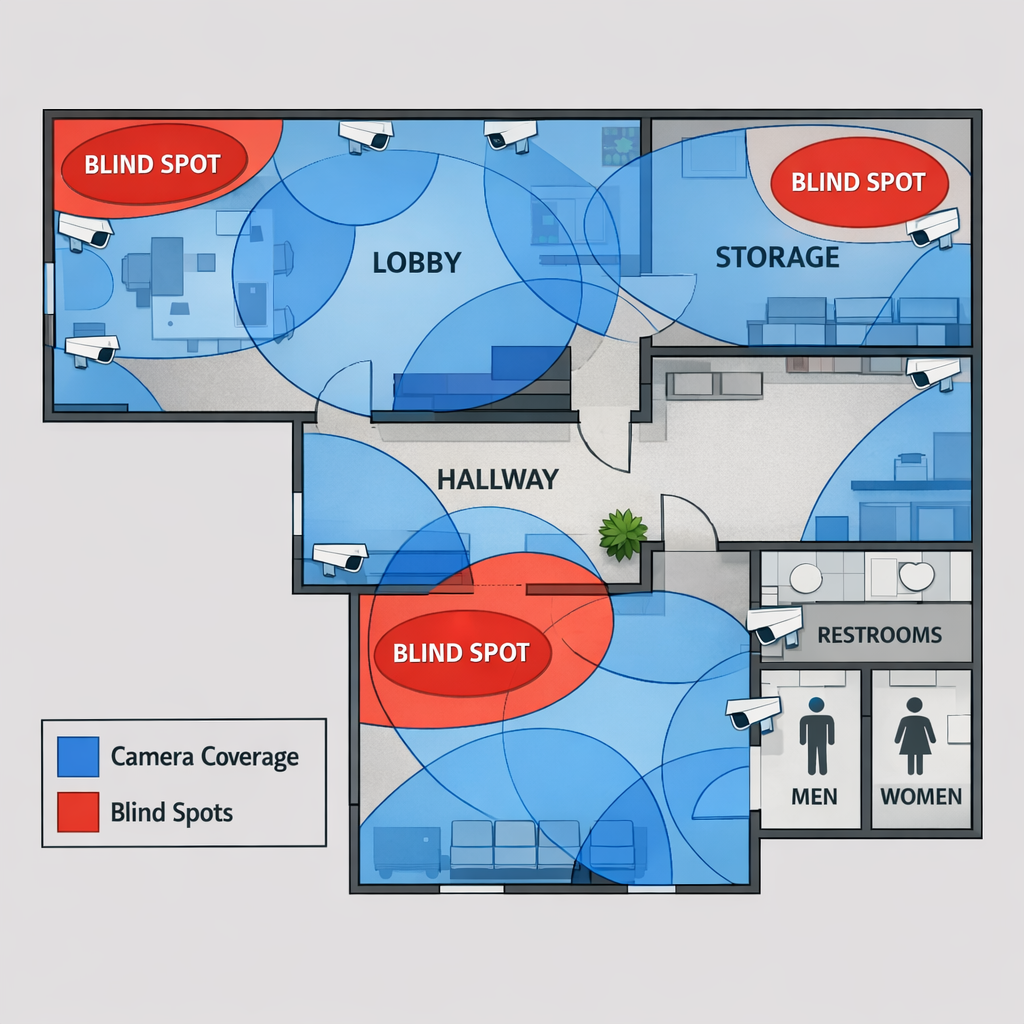
Common surveillance blind spots around entrances and loading areas
Entrances and loading docks concentrate risk: they are high-traffic, access-control and handoff points where theft, tailgating, and vehicle-related incidents occur. Surveillance blind spots here typically appear behind signage, under awnings, between bollards, and in vehicle pickup bays where standard wall-mounted business security cameras capture faces at odd angles or miss license plates. Effective placement begins by mapping expected sight lines at typical approach heights and vehicle lanes, then addressing occlusions caused by lighting fixtures, doors, and temporary loading equipment.
Start with a physical walk-through at peak activity times and note areas where operators naturally block camera views. For entrances, tilt and height matter: low wall-mounted cameras often capture torso-level motion but miss faces when people stoop or cluster; high single-angle cameras miss facial detail. At loading docks, shadows and reflective trailers can render CCTV footage unreadable unless you pair camera positioning with appropriate exposure control and HDR-capable sensors. Use this process to produce a coverage grid before selecting cameras. Read the complete Video Surveillance guide
Mitigating surveillance blind spots in hallways and inventory zones
Hallways and inventory zones present different challenges: confined corridors create blind zones in blind corners and behind shelving while inventory zones feature vertical clutter and variable aisle widths that defeat simple pan-tilt solutions. Warehouse surveillance should balance wide-area situational awareness with targeted detail in high-value aisles. Office security cameras in corridors need to consider privacy corridors and sight lines into private offices.
Mitigation techniques include staggered overlapping coverage so no aisle depends on a single camera view, angled ceiling mounts at aisle ends to reduce occlusion behind racks, and selective use of fisheye or multi-sensor arrays to cover wide spans while retaining the ability to extract rectified views for evidence. In warehouses where forklifts operate, position cameras above typical load heights and protect them with cages to reduce blind spots created by moved inventory.
Comparison: camera types and positioning for closing blind spots
Choosing the right camera class is a comparison exercise: fixed box cameras provide high-resolution images for focused points, PTZ (pan-tilt-zoom) cameras can track activity but may miss events outside their patrol patterns, and multi-sensor or panoramic units deliver broad coverage but can sacrifice detail per angle. CCTV coverage improves when you mix types based on zone function rather than applying one model across the site.
Pros and cons by scenario
- Entrances: Fixed, high-resolution lenses aimed at doors and ID heights capture faces and badges reliably. PTZs add tracking for crowd control but require rules to avoid leaving areas unmonitored.
- Loading areas: A combination of overhead wide-angle and angled plate-focused cameras improves license plate capture and activity context. Thermal sensors can supplement visible cameras for night operations.
- Hallways: Ceiling-mounted fixed cameras with overlapping views reduce corner blind spots; panoramic units can reduce camera count but require video analytics to extract meaningful clips.
- Inventory zones: Multi-sensor arrays or staggered fixed cameras on rack ends prevent occlusion by stacked goods and moving equipment.
Consider camera positioning together with lighting upgrades, reflective-surface mitigation, and network video recorder settings (compression and retention) to optimize actual CCTV coverage instead of theoretical sight lines.
Practical examples and common mistakes
Real-world scenarios highlight the decision logic that prevents repeatable blind spots.
- Example 1 — Retail entrance: A boutique installed three identical wall cameras above the door. They captured wide views but not faces because each was angled too high. Correction: replace one with a lower fixed camera focused on facial height and adjust exposure settings to handle backlighting at glass doors.
- Example 2 — Small warehouse: Management relied on a single PTZ on a 20-foot pole to monitor several aisles. The camera missed events while panning. Correction: add fixed cameras at aisle ends and program PTZ presets for intrusion tracking only.
- Example 3 — Office corridor: Cameras were placed to cover doors but inadvertently pointed into private cubicles, raising privacy complaints. Correction: re-angle cameras to monitor corridors and entrances only; crop or blur windows in analytics to protect sensitive areas.
Common mistakes to avoid include: assuming higher resolution replaces good placement, clustering cameras to simplify wiring instead of guaranteeing overlap, underestimating the effect of reflective surfaces and shadow bands, and ignoring access control data that can correlate blind-spot events. For each mistake, create a measurable acceptance criterion: minimum face pixel height at 3 meters, unobstructed plate capture zone between 3–15 meters, or less than one occlusion per month in high-value aisles.
Legal & ethical considerations (US and EU overview)
When you close surveillance blind spots, legal boundaries determine where you can place business security cameras and what you can record. In the US, rules vary by state: expect limits on audio recording without consent and privacy protections for areas where people have a reasonable expectation of privacy, such as restrooms and private offices. In the EU, GDPR applies to personal data collection; video footage that can identify an individual is personal data and must be processed lawfully, transparently, and for a specific purpose.
Operational best practices include publishing clear signage at entrances and affected zones, limiting retention to what is necessary for the stated purpose, restricting access to footage by role, and logging viewer access. Where audio would close a gap, consult counsel because in many jurisdictions audio requires separate consent. Document your coverage map and retention policy as part of compliance records. Discreet solutions
Buyer guide: evaluation criteria and selection logic
Selecting cameras to close surveillance blind spots is a buyer decision driven by functional criteria, not brand impressions. Evaluate potential purchases against a checklist that ties back to your mapped gaps:
- Coverage requirements: Does the camera's field of view and resolution satisfy your face, plate, and item-read requirements at the expected distances?
- Low-light and high-contrast performance: HDR capabilities and infrared range affect entrances and loading docks more than well-lit interior hallways.
- Form factor and protection: Can the camera be mounted to avoid accidental occlusion by material handling equipment, and does it have vandal-resistant housing?
- Analytics compatibility: If you need object detection, loitering alerts, or inventory motion analytics, verify that camera firmware or your VMS supports the required modules.
- Network and storage: Ensure bandwidth and retention plans keep footage for the legally required or operationally necessary period without dropping frames.
Avoid selection mistakes such as buying highest-megapixel devices without considering lens quality or selecting PTZs as a cost-saving replacement for overlapping fixed coverage. For product research and range comparisons, consult our category resources when shortlisting equipment. Browse Video Surveillance
Frequently Asked Questions
Q1: How do I quickly identify my most critical surveillance blind spots? Walk the site during operational peaks, sketch sight lines, and note occlusions from shelving, signage, and vehicles. Use a checklist that captures face/plate/asset-read requirements by zone.
Q2: Can I rely on PTZ cameras to remove the need for multiple fixed cameras? No. PTZs offer tracking but can create gaps while panning; pair PTZs with fixed or multi-sensor cameras to maintain continuous coverage.
Q3: Are there cost-effective ways to improve CCTV coverage without replacing all cameras? Yes. Repositioning, adding inexpensive fixed units at critical corners, improving lighting, and tuning exposure settings often yield large coverage gains for lower cost.
Q4: What privacy measures should I put in place when expanding coverage? Post clear notices, limit retention, restrict viewer access, mask or blur sensitive regions in footage, and document the lawful basis for recording in the EU context.
Q5: How should I balance resolution and storage when closing blind spots? Choose resolution based on the forensic requirement (face, plate, item). Use targeted high-resolution cameras where detail matters and lower resolution for broad situational awareness; optimize codecs and retention policies accordingly.
Closing notes — an educational summarization
Addressing surveillance blind spots, business security cameras, CCTV coverage is a methodical process: map risks, select the right camera types and placements, compare solutions by scenario, and incorporate legal and operational controls. The objective is measurable coverage that supports safety and loss prevention without overreaching into private spaces. Maintain a living coverage map and revisit camera positioning whenever workflows, inventory layout, or access patterns change so that your CCTV coverage continues to reflect the realities of daily operations.
For foundational system planning and references on video surveillance principles, consult the video surveillance primer in our knowledge base to align physical coverage with policy and retention decisions.