Geofencing GPS tracker for Home and Fleet Vehicles: How Virtual Boundaries Alert Before Theft
A geofencing GPS tracker is a vehicle GPS tracker feature that defines virtual boundaries around driveways, commercial yards, or city blocks and triggers GPS alerts the moment a vehicle begins to cross that boundary. For homeowners and small-fleet operators, that early-alert behavior turns passive tracking into proactive theft prevention: you get notified before a vehicle leaves a designated safe area so you can intervene or escalate to responders. Read the complete GPS Trackers guide
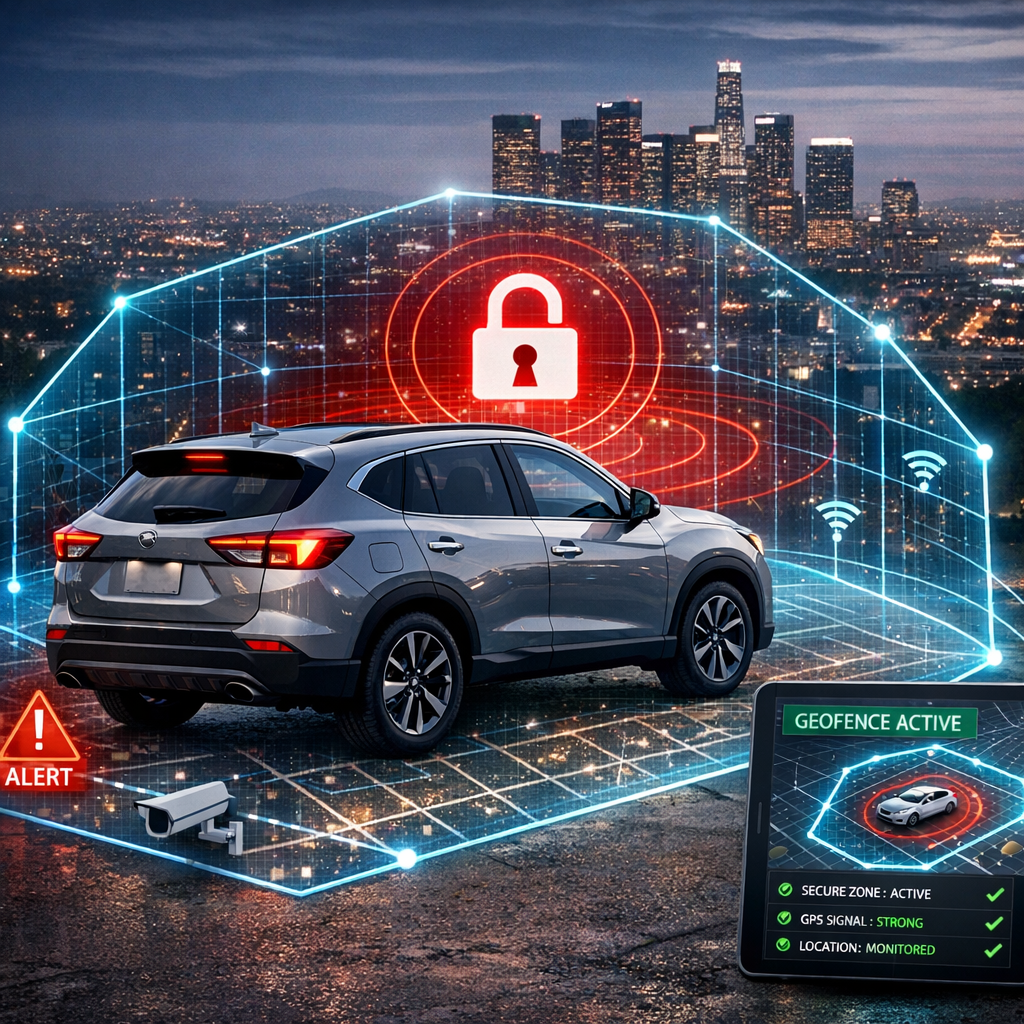
How a geofencing GPS tracker creates virtual boundaries and pre-departure alerts
At its core, geofencing combines GPS coordinates with logic rules. A user defines a polygon or radius on a map and assigns parameters: allowed directions, time windows, speed thresholds, and alert recipients. The vehicle tracking system continuously compares the tracker’s real-time location to the defined zone. When the device detects an exit event that matches the rule set, it generates an immediate GPS alert to the configured channels (mobile push, SMS, email, or central monitoring). That alert triggers actions: verify whether the movement was authorized, disable ignition in integrated systems where lawfully permitted, or contact security personnel.
Geofencing GPS tracker: technical components and failure modes
Understanding how the components interact helps evaluate reliability. A typical geofencing GPS tracker system includes the GPS receiver, cellular or satellite uplink, onboard firmware that evaluates geofence logic locally or on the cloud, and a backend notification engine. Failure points include GPS signal loss (covered areas, dense urban canyons), cellular outages, incorrect geofence geometry, and latency in cloud processing. Systems that support local geofence evaluation on the device can send near-instantaneous local alerts, while cloud-based rules may introduce seconds to minutes of delay depending on connectivity.
Pros and cons of local vs cloud geofence evaluation
- Local evaluation: Lower latency, works during temporary loss of backend connectivity, but requires more capable (and often costlier) hardware and firmware updates.
- Cloud evaluation: Easier to manage complex rules and bulk updates, integrates with analytics and reporting, but relies on continuous uplink and may delay alerts in weak-signal environments.
Comparison: geofencing GPS tracker options and vehicle tracking system features
Not all vehicle GPS trackers offer the same geofencing capabilities. Evaluate systems by these dimensions: precision of zone drawing (radius vs polygon), supported alert channels, conditional rules (time of day, direction), tamper and power-cut detection, integration with immobilizers, and audit logging for compliance. For business users, look for fleet-level dashboards with role-based access and event escalation chains. For homeowners, simplicity and reliable push alerts may matter most. Discreet solutions
Scenarios where one design outperforms another
- Residential driveway theft: a device with fast local evaluation and low-power continuous GPS is most effective to generate immediate alerts.
- Fleet yard monitoring: cloud-based rules with multi-user escalation and audit logs support compliance and incident tracking across shifts.
- Urban valet and valet-recovery services: precise polygon geofences reduce false positives in dense environments where a simple radius would trigger unnecessarily.
Use cases: real-world scenarios and decision logic
Practical use cases illustrate decision logic for deployment and response.
Homeowner with a single vehicle
Define a geofence around the property perimeter and set alerts for any early morning or overnight exits. Use SMS and push notifications for immediate awareness, and include tamper detection so you’re alerted if a tracker is unplugged. Decision logic: if an alert occurs during a scheduled “parked” window, verify with a quick call. If unverified, notify authorities with location data.
Small landscaping business with several trucks
Create compound geofences (yard vs. route start points) and restrict off-hours travel. Configure multi-recipient alerts to the dispatcher and owner, and enable historical route playback when investigating suspicious movement. Decision logic: if a vehicle exits during off-hours, dispatcher calls operator; if unreachable, escalate to law enforcement with fleet ID and last-known heading.
Buyer guide: evaluation criteria, common mistakes, and selection logic
Choosing the right geofencing GPS tracker requires balancing accuracy, alert timeliness, features, and compliance. Key evaluation criteria include:
- Geofence precision: Prefer polygon support for complex sites.
- Alert latency: Test device and system under local signal conditions.
- Rule complexity: Time-based, direction-aware, and speed-conditioned rules reduce false positives.
- Integration: Check compatibility with immobilizers, fleet management, and incident reporting tools.
- Power and tamper resilience: Hardware should detect power-cut, low-battery, and disconnection events.
- Privacy and data retention: Confirm how long location logs are stored and who has access.
Common mistakes to avoid: relying on a single alert channel, drawing overly large geofences that produce noise, ignoring cellular coverage in your area, and omitting tamper detection. Before purchase, trial the unit in the intended environment and review analytics sample exports to ensure logs meet operational needs. For product catalog and options suitable for small business and homeowner use, check the product category and filter by device capabilities. Browse GPS Trackers
Practical examples and common mistakes
Example 1: A homeowner creates a 200-meter-radius geofence around the house. A courier’s route through the neighborhood repeatedly triggers alerts. The mistake: radius too large and not time-restricted. Fix: convert to a tight polygon and limit alerts to off-hours.
Example 2: A fleet manager enables geofence alerts but routes them only to a generic support inbox. When a truck exits at night, the notification is missed. The mistake: unspecified escalation. Fix: route critical alerts to mobile devices and designate an on-call responder.
Example 3: A small-business owner buys a low-cost tracker without tamper detection. After an attempted theft, the device is removed before cloud processing detects the exit. The mistake: omitted tamper and power-cut alarms. Fix: choose models with independent backup power and tamper sensors.
Legal and ethical considerations (high-level: EU and US)
Geofencing and continuous vehicle tracking raise both privacy and regulatory questions. In the EU, GDPR principles apply when personal data is processed: minimize retention, document lawful basis (typically legitimate interest for theft prevention), implement data access controls, and provide transparency where required. In the US, federal law does not uniformly regulate location data; state laws vary and employer use may be constrained by labor and privacy statutes. Always document privacy impact assessments, restrict access to location logs, and obtain consent or provide clear notice when tracking employee-operated vehicles. Avoid enabling remote immobilization features where local regulations restrict control over vehicle operation, and consult legal counsel for use in shared or public-carriage contexts.
Frequently Asked Questions
Can a geofencing GPS tracker alert me before my car is stolen? Yes. Properly configured geofences and low-latency alerting let you know when a vehicle begins to leave a defined area, which can prevent theft by enabling rapid response.
How accurate are geofence alerts in urban areas? Accuracy depends on the tracker's GPS chipset, antenna placement, and signal obstruction. Urban canyon effects can reduce precision; polygon geofences and supplemental technologies (cell-tower triangulation, assisted GPS) improve reliability.
Will geofencing work if the tracker is disabled? If the tracker is physically removed or loses power, well-designed systems send tamper and power-cut alerts before location data stops. Some devices include backup batteries to extend alert capability.
Are geofence alerts legal for employee vehicles? They can be, but employer tracking must respect local laws and employee privacy. Use clear policies, limit data retention, and restrict tracking to business hours when possible.
Which alert channels are most effective? Push notifications and SMS provide immediate awareness; email is useful for archives. For high-risk assets, multi-channel escalation (push → SMS → call) reduces missed events.
Educational closing
Geofencing transforms vehicle GPS trackers from passive location loggers into proactive theft-prevention systems by defining virtual boundaries and generating alerts when those boundaries are violated. Selecting the right device and configuring precise rules, low-latency alerting, tamper detection, and appropriate escalation are the central decisions for homeowners and small businesses. Consider coverage and technical trade-offs between local and cloud geofence evaluation, document privacy and compliance controls, and pilot systems in real conditions to tune rules and minimize false positives. Thoughtful implementation gives you earlier awareness and better options to stop theft before a vehicle leaves a secure area.