Voice recorders for homeowners: avoid missed recordings with sensitivity tuning
Proper configuration of voice recorders is the most reliable way for homeowners, small offices, and professionals to avoid missed recordings while staying within legal and ethical boundaries. This article explains how voice activation sensitivity works, compares configuration choices across environments and device types, and gives practical step-by-step settings to reduce failures without increasing false triggers.
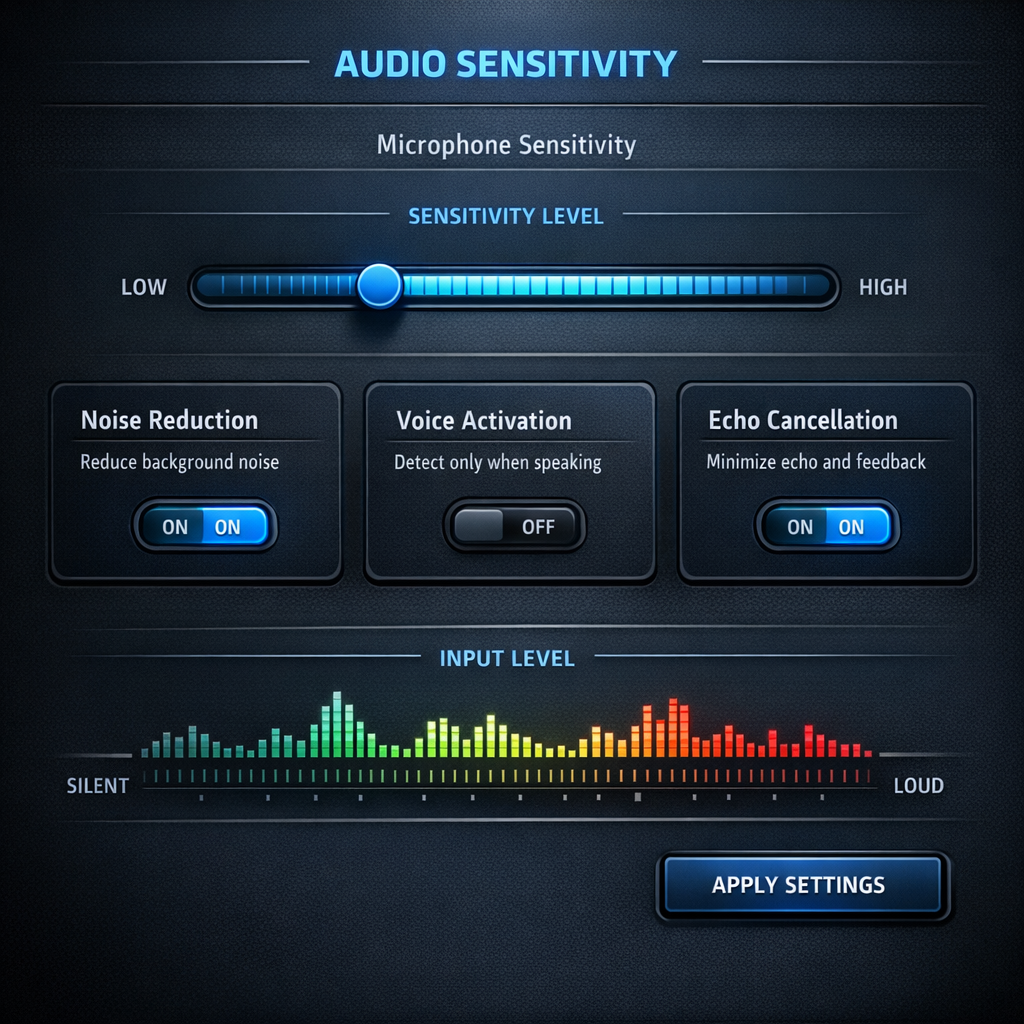
How voice recorders use voice activation sensitivity
Most modern voice recorders include a voice activation feature that starts and stops recording automatically when sound crosses a threshold. Sensitivity defines that threshold and interacts with other parameters—pre-roll buffering, trigger delay, hysteresis, and noise gating—to determine whether a spoken phrase will be captured. Lower sensitivity requires louder or closer speech to trigger recording; higher sensitivity accepts quieter sounds but risks recording ambient noise. Understanding this interaction is essential for matching settings to use cases. For technical reference on professional recording and discreet operation, consult the pillar resource for advanced methods Read the complete Voice Recorders guide .
Common types of voice activation and their trade-offs for voice recorders
Voice activation implementations differ by algorithm and hardware. Key categories include energy-threshold detectors, spectrum-based detectors, and machine-learning voice activity detectors (VAD). Each has trade-offs:
- Energy-threshold detectors: Simple, low-power, and predictable. They work well in quiet environments but miss distant or soft voices in noisy settings.
- Spectrum-based detectors: Analyze frequency bands characteristic of human speech. Better at ignoring steady background hum but require more processing and careful calibration of sensitivity per band.
- Machine-learning VADs: Use pattern recognition to distinguish speech from noise. Most robust in complex environments but can be opaque in behavior and may need firmware updates for optimal performance.
When selecting a device, consider the recorder's detector type and whether firmware updates or adjustable parameters are available on the product page Browse Voice Recorders.
Configuring voice recorders for different environments
Environment determines safe starting points for voice activation sensitivity and related settings. Here are recommended baselines and adjustment logic.
Quiet indoor (small meeting room, home office)
Start with moderate sensitivity: a threshold that triggers reliably for normal conversational volume 1–2 meters away. Enable a short pre-roll buffer (0.5–1 second) so the recorder captures the initial syllable. Use a short trigger delay (50–150 ms) to prevent chopping off clipped consonants. If the unit supports voice activation hysteresis, enable a small hang time (1–2 seconds) to avoid repeated stop/start on brief pauses.
Noisy indoor (busy cafe, shared workspace)
Increase trigger threshold (lower sensitivity) and rely on spectrum-based or ML detectors if available. Extend pre-roll minimally (0.2–0.5 s) to conserve space but set a slightly longer hang time (2–3 seconds) to bridge conversational gaps. Consider directional microphones or placing the recorder closer to primary speakers to reduce background triggers.
Outdoor or distant sources
These scenarios often require maximum sensitivity and larger pre-rolls (1–3 seconds). If possible, use an external microphone closer to the speaker. Beware that raising sensitivity increases false positives; combine with post-processing filters or manual review for critical captures.
Choosing voice recorders: evaluation criteria and buyer guidance
When evaluating units, weigh the following criteria in decision logic rather than relying on marketing labels:
- Adjustable sensitivity range: Devices that expose a numeric sensitivity scale or discrete low/medium/high options give you control over trigger behavior.
- Pre-roll and post-roll capability: Pre-roll captures initial words; post-roll ensures endings are saved after silence returns. Both reduce missed content.
- Trigger delay and hang time: Fine-grained control over these prevents clipping and repeated files from short pauses.
- Microphone quality and placement options: Directional mics and external inputs reduce background triggers and improve effective sensitivity.
- Processing algorithms and updates: Devices with firmware updates and ML-based VAD typically improve performance in varied conditions.
Use a decision path: define your primary use case (e.g., interview, home monitoring, meeting minutes), rank the criteria above for that use, then select devices whose specifications and control interfaces match the ranked needs. For product collections and model comparisons within this category, review the collection overview and cross-reference the deeper methods in our technical resource Discreet solutions.
Practical examples and configuration recipes
These examples show concrete starting configurations and adjustment logic for real-world scenarios.
- Home interview in a quiet room: Sensitivity = medium-low, pre-roll = 1 s, trigger delay = 100 ms, hang time = 1.5 s. Place recorder 30–50 cm from subject.
- Recorder for baby-monitoring in a bedroom: Sensitivity = medium-high, pre-roll = 0.5 s, post-roll = 2 s, enable noise suppression. Beware of continuous noise sources like fans that raise the ambient floor.
- Small business meeting with multiple speakers: Sensitivity = medium, pre-roll = 0.5 s, hang time = 2 s, use omnidirectional mic centered on table. If frequent false starts occur, slightly lower sensitivity and bring recorder closer to primary speaker.
When tuning, change only one parameter at a time and run a 5–10 minute test sequence simulating typical interaction. Log settings and results so you can revert to the last successful configuration rather than guesswork.
Common mistakes that cause missed recordings
Practitioners often make predictable errors that lead to missed audio. Recognize and avoid these:
- Setting sensitivity too low for distance: Expect attenuation with distance; adjust sensitivity and microphone placement together.
- Disabling pre-roll: This can chop initial consonants or the first word—especially problematic in short exchanges.
- Using automatic settings without testing: Auto modes can change thresholds based on perceived noise and may assume a different environment than your use case.
- Ignoring firmware and algorithm updates: Improvements to VAD can reduce missed recordings; test after updates.
- Relying on a single recording channel in multi-speaker settings: Multiple mics or careful placement reduces the chance all voices are missed when the trigger relies on one weak source.
Legal and ethical considerations (EU and US high-level)
Legal frameworks differ between jurisdictions, and configuration choices can create compliance risks. In the EU, data protection under GDPR requires clear lawful bases for recording in many contexts, particularly where recordings may identify individuals or contain personal data. Reasonable expectations of privacy matter: a private conversation in a home requires consent in most cases. In the US, laws vary by state—many are one-party consent states, but several require all-party consent for audio recording. In business settings, explicit policies and clear signage where required reduce legal risk.
Ethically, configure devices to minimize incidental capture of bystanders. Use targeted placement, conservative sensitivity when recording in mixed-use areas, and retention limits to delete unneeded recordings promptly. When recordings are sensitive, restrict access, encrypt stored files if possible, and document the purpose and legal basis for retention.
Frequently Asked Questions
Q1: How do I set sensitivity to avoid missing whispered speech?
Increase sensitivity and add a longer pre-roll; however, also test to ensure ambient noise doesn’t create too many false recordings. If whisper capture is critical, use a closer or lavalier microphone.
Q2: Will firmware updates change my sensitivity settings?
Sometimes. Updates can alter VAD behavior; always retest after major updates and keep a record of working configurations.
Q3: Can I trust an "auto" sensitivity mode for reliable capture?
Auto modes are convenient but can be inconsistent across environments. Use auto for non-critical tasks, and switch to manual settings for interviews or legal evidence collection.
Q4: What pre-roll and post-roll values should I choose?
Start with 0.5–1 second pre-roll to secure initial speech and 1–2 seconds post-roll to ensure endings. Adjust based on the pace of speech and storage constraints.
Q5: Does increasing sensitivity always improve recording reliability?
No. Higher sensitivity increases false positives from ambient noise. The optimal approach balances sensitivity with placement, mic type, and processing algorithms rather than maximizing sensitivity alone.
Closing: practical next steps
Avoiding missed recordings with voice recorders requires a systematic approach: understand the detector type, start with environment-appropriate baseline settings, test with representative audio, and iterate conservatively. Keep an audit of settings that worked, monitor firmware updates, and apply legal checks for consent and retention. For further reading on discreet and professional recording techniques, the pillar article provides advanced procedures and examples ; for product selection within the category, consult the collection overview and compare practical setups with our secondary technical resource .