Video Surveillance Camera Placement Strategies for Homes and Small Businesses
Effective video surveillance begins with strategic camera placement: decisions about height, angle, field of view, and lighting directly determine whether footage can identify a person, vehicle plate, or sequence of events. This article focuses on placement strategies that improve identification and overall evidence quality while balancing legal boundaries and practical constraints for homeowners and small businesses.
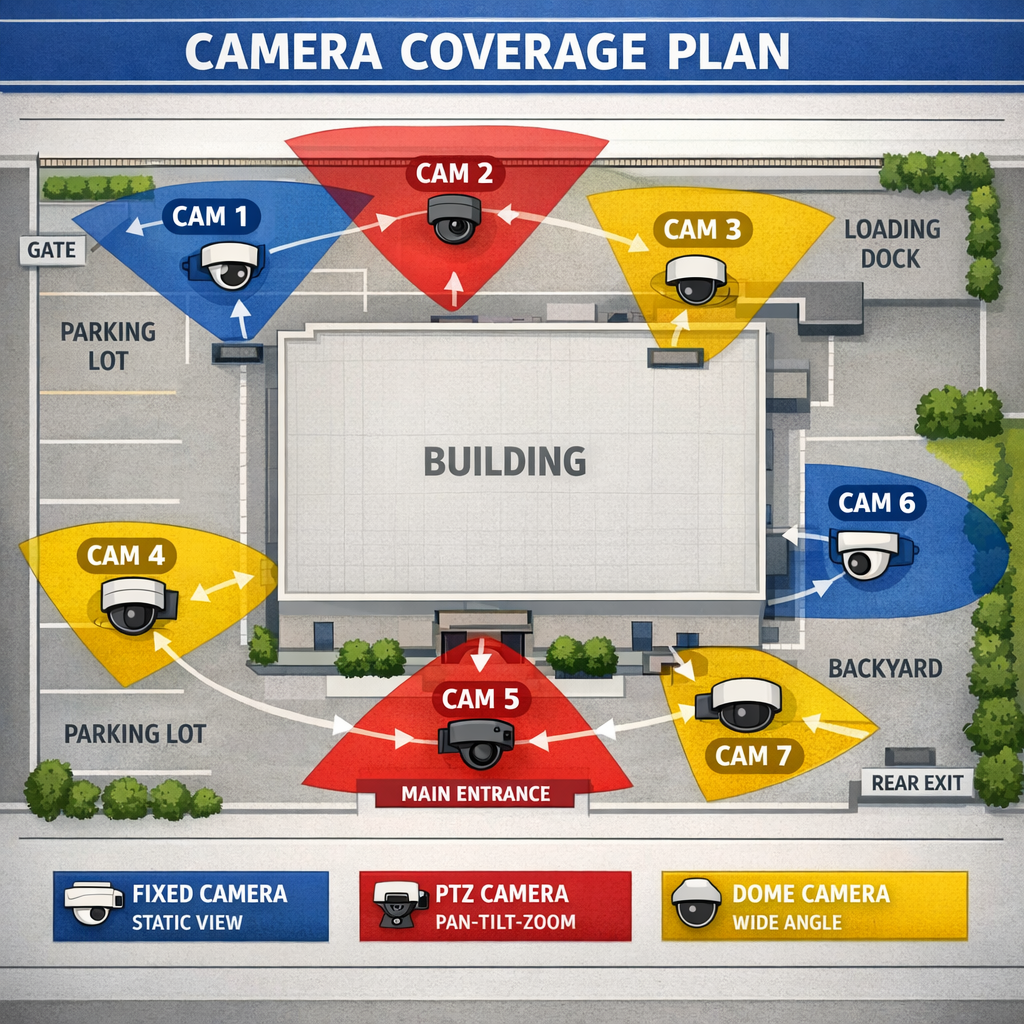
Video surveillance: placement principles to improve identification
Start placement planning by defining the primary identification goals for each scene: facial recognition at entry points, license-plate capture at driveways, or activity overview for large spaces. Face-level identification typically requires camera placement at 5–7 feet above ground, angled to avoid extreme tilt that distorts facial features. For vehicles, a lower, near-horizontal angle combined with a narrow field of view and higher resolution helps capture license characters. Wide-angle cameras can be used for situational awareness, but they trade detail for coverage; pair them with zoom-capable or focused cameras where identification is essential. Consider environmental factors such as backlighting and reflective surfaces and position cameras to minimize direct sun or glare across the lens.
Video surveillance placement strategies compared: pros, cons, and scenarios
Choosing a placement strategy requires comparing trade-offs. Broadly, strategies fall into three categories: overview coverage, focused identification, and hybrid layouts. Overview coverage uses high-mounted wide-angle cameras to monitor large zones and deter misconduct. Pros: fewer cameras, continuous situational context. Cons: lower evidence quality for identities. Focused identification concentrates cameras on likely face and plate capture points. Pros: high evidence quality and identification rates. Cons: more cameras and planning. Hybrid layouts combine both to balance deterrence and forensics.
Fixed wide-angle vs. narrow/zoom placements
- Wide-angle fixed: Best for lobbies, retail floor plans, and parking areas where behavior patterns matter; poor for identifying faces at a distance.
- Narrow/telephoto: Best for entries, payment counters, and access roads where identification is required; requires careful aiming and higher resolution.
- PTZ (pan-tilt-zoom): Flexible for active monitoring; human or analytics control can track subjects, but PTZs may miss incidental evidence when not actively focused.
Scenario example: a small retail store pairs a ceiling-mounted wide-angle camera for floor coverage with a chest-height, narrow-focus camera above the point-of-sale for clear facial capture and register footage. That combination improves evidence quality while keeping equipment count reasonable. Read the complete Video Surveillance guide
Camera placement use cases and decision logic
Decision logic flows from purpose: deter, document, or identify. For deterrence, prioritize visible, elevated cameras covering entrances and parking. For documentation, ensure overlapping coverage so events are recorded by multiple angles. For identification, place smaller numbers of cameras with constrained fields of view, high pixel density, and consistent lighting. Below are typical use-case placements:
- Residential front entry: Mount a camera at 6–7 feet centered on the door, angled slightly downward to capture faces and interactions. Supplement with a doorbell camera for close-up verification.
- Small business storefront: Use one wide exterior camera for street and sidewalk behavior, and a narrow-focus camera over the main entrance for identity capture—ensure sign-in lighting is adequate at night.
- Warehouse loading dock: Combine overview cameras for process monitoring with high-resolution cameras directed at loading bays and plate capture points.
Environmental conditions should drive specific placement choices: avoid placement directly opposite reflective windows or glossy floors that can produce lens flare, and consider weatherproof housings for outdoor units. When possible, use test recordings to validate that intended subjects are captured clearly from proposed mounting points.
Practical examples and common mistakes
Practical examples highlight common errors and corrective placement techniques. A homeowner who places cameras too high (e.g., above 12 feet) often ends up with subject heads that are too small to identify; solution: lower or add a mid-level camera. A retailer mounting a single wide-angle camera behind a counter may miss faces obscured by high shelving; solution: reposition to a frontal angle or add a counter-facing camera. In parking lots, mounting cameras behind foliage or under eaves that cast shadows reduces evidence quality; prune sightlines and elevate mounts to maintain clear sightlines.
Common mistakes include relying solely on peak coverage metrics instead of testing for identification, ignoring lens focal length impact on pixel density, and underestimating night-time lighting needs. Another frequent oversight is failing to align camera placement with retention and export requirements that affect admissible evidence quality during investigations.
Selecting equipment with placement and evidence quality in mind
Camera selection should be guided by expected mounting locations and identification goals. Key evaluation criteria include sensor resolution, lens focal length, low-light performance (measured as minimum lux or IR range), shutter and frame rate for motion clarity, and mounting options. For identification, prioritize higher-resolution sensors (4MP and above for medium-distance faces), narrow-angle lenses for focused capture, and adjustable mounts to fine-tune aim. For broad coverage, lower-resolution wide-angle cameras suffice, but they must be supported by at least one dedicated identification camera per critical access point.
Buyer mistakes to avoid: purchasing cameras based on marketing specs alone without considering effective pixels per face or plate at the intended distance; neglecting on-site testing; and assuming cloud compression will preserve detail—compressive storage settings can degrade evidence quality. Browse Video Surveillance
Video surveillance legal & ethical considerations
Placement that improves identification must also respect legal boundaries and privacy expectations. In both the EU and US, key considerations include avoiding audio capture without consent where local law restricts it, not pointing cameras into private areas such as neighboring windows or bathrooms, and maintaining clear signage where required. Data protection rules in the EU (GDPR) emphasize purpose limitation, data minimization, and secure storage; document your lawful basis for surveillance and retention periods. In the US, state laws can vary on audio recording and expectations of privacy, and footage used in investigations should be handled according to evidence-chain best practices.
Operational controls supporting legal compliance include restricted access logs, role-based review permissions, and clear retention schedules tied to legitimate business purposes. When in doubt, choose placement that focuses on public-facing access and key business assets rather than gratuitous coverage of bystanders. Discreet solutions
Frequently Asked Questions
Q1: How high should I mount cameras for facial identification?
Mount cameras roughly 5–7 feet above ground, angled slightly downward to capture faces without extreme perspective distortion; adjust for camera focal length and subject distance.
Q2: Will a single camera per entrance be enough to identify someone?
Not always. A single camera may fail if lighting, angle, or occlusion occurs; pairing a wide-angle deterrent with a focused identification camera at entry is a more reliable approach.
Q3: How does camera placement affect evidence quality for legal use?
Placement influences framing, pixel density on subjects, and the likelihood of clear, usable footage. Proper placement increases evidentiary value by ensuring subjects are recorded at sufficient resolution and angle for identification.
Q4: Are there privacy rules I must follow for outdoor cameras?
Yes. Avoid directing cameras at areas with an expectation of privacy (private windows, bathrooms) and comply with local signage, audio consent, and data retention laws; requirements differ between jurisdictions.
Q5: How should I test placement before final installation?
Perform trial recordings at different times of day, simulate events (walks, vehicle passes), and review footage for facial clarity, plate legibility, and unwanted glare; adjust mounts and lighting until evidence quality meets your identification goals.
Educational closing
Improving identification through intentional camera placement is a technical and procedural task: define clear identification objectives, select placements that maximize pixel density on intended targets, compare strategies for trade-offs between coverage and detail, and document decisions with test recordings. Combine these placement practices with legal and operational safeguards to preserve evidence quality and reduce privacy risk—this systematic approach yields more useful video surveillance results for homeowners and small businesses while keeping compliance and ethics central to deployment.