Voice recorders: Comparing voice-activated vs continuous recording for homeowners and small businesses
When voice recorders rely on voice activation, missed recordings become a practical and legal concern for homeowners, small businesses, and professionals who need reliable evidence or accurate meeting logs. Early in device selection you must weigh sensitivity settings, trigger latency, and storage behavior against privacy and compliance obligations. Read the complete Voice Recorders guide
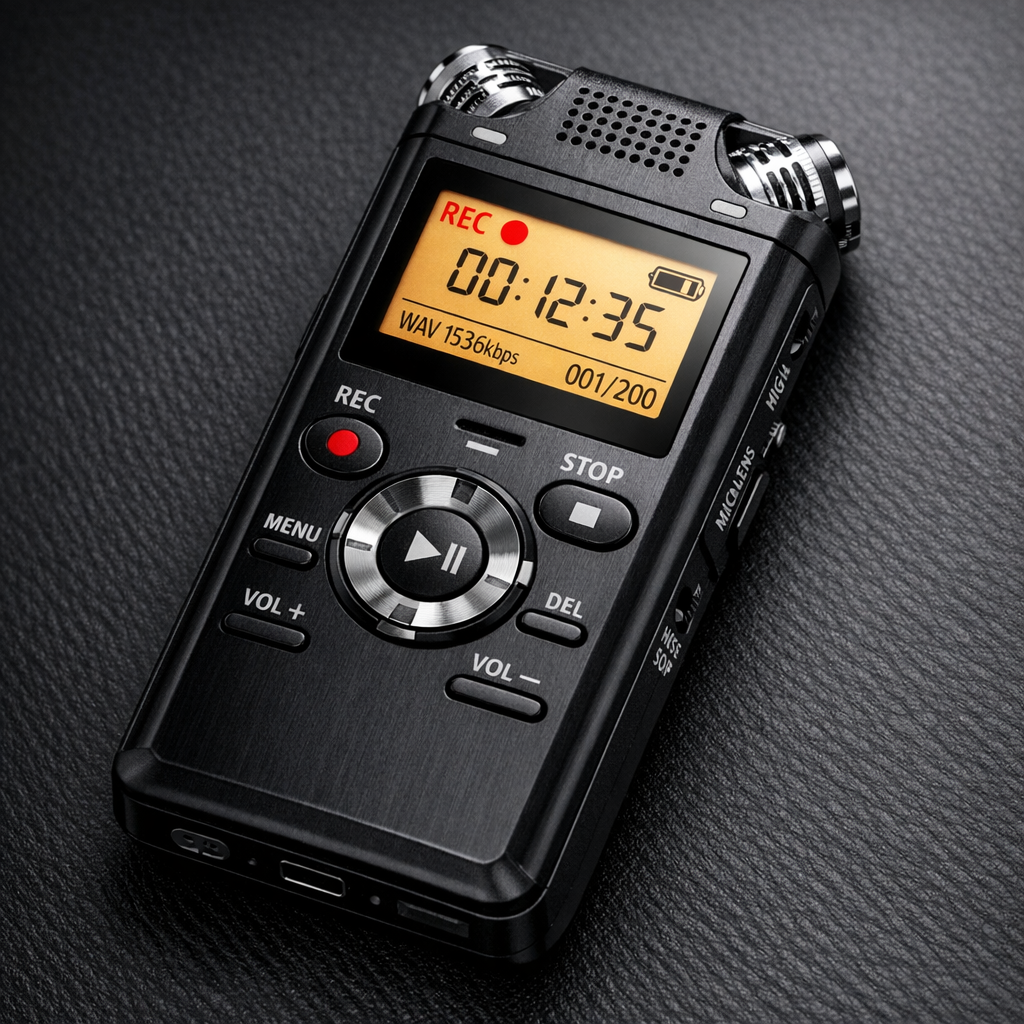
How voice recorders with voice activation compare to continuous recording
Comparing voice activated recorders and continuous digital voice recorder models requires a focused look at how each approach captures sound. Voice-activated devices use a threshold or algorithm to start saving audio only when detected input exceeds background noise. Continuous recorders capture a steady stream at a fixed bitrate and save either in rolling files or extended tracks. The trade-offs affect evidentiary value, battery life, storage consumption, and the risk of gaps where crucial speech is lost.
Pros and cons at a glance
- Voice-activated pros: longer battery runtimes, reduced file volume, easier manual review when activity is sparse.
- Voice-activated cons: missed low-volume speech, trigger latency, false negatives during overlapping noise or distant talkers.
- Continuous pros: complete timeline of audio, predictable file structure, fewer legal questions about edited gaps.
- Continuous cons: larger storage needs, higher power draw, more time needed to locate relevant segments.
Choosing voice recorders: trade-offs, scenarios, and selection criteria
Selection should begin with the use case. For a homeowner documenting occasional contractor conversations, a voice activated recorder can extend unattended runtime. In contrast, a small legal practice documenting client intake or an HR manager monitoring sensitive interviews should favor continuous recording to avoid losing subtle statements. Consider these device attributes:
- Sensitivity and threshold controls: Devices that allow adjustable trigger levels reduce missed recordings but require calibration to environment.
- Pre-roll buffering: Models that buffer a few seconds of audio before activation can capture context missed by plain trigger-only devices.
- Time-stamping and file integrity: Reliable timestamps and non-rewritable logs improve the evidentiary chain for professional uses.
- Battery and storage architecture: Replaceable batteries and support for large-capacity SD cards favor long continuous sessions; energy-efficient codecs help with voice-activated use.
- Microphone quality and placement: High SNR mics, directional capsules, or external mic support change real-world performance more than raw specs.
For shopping focused on devices organized by feature or price, review the category selection and filter by mode (voice-activated vs continuous), bit rate, and buffer options. Browse Voice Recorders
Performance comparison: real-world scenarios
Compare how each mode performs in specific settings rather than relying on manufacturer claims. Below are common scenarios with practical outcomes.
Scenario 1 — Contractor conversations at doorsteps
Outdoor ambient noise and intermittent speech favor a voice activated recorder with strong buffering. A plain voice-activated mode without pre-roll will often miss initial statements like price quotes or instructions. A digital voice recorder configured with a 3–5 second pre-roll or continuous low-bitrate recording minimizes loss while conserving storage.
Scenario 2 — Staff interviews in small offices
In enclosed offices, continuous recording reduces risk: whispered admissions or short, critical comments can be missed by voice activation if below the threshold. For compliance-sensitive interviews, continuous recording is the safer default.
Scenario 3 — Remote field observations
Fieldwork with infrequent speech benefits from voice activation to conserve battery and storage. However, place and orientation matter: a distant subject or soft speech requires sensitive trigger settings and a microphone with good gain or external mics to reduce missed audio.
Practical examples and common mistakes
Real users often repeat avoidable errors that create missed recordings or raise legal problems. Learn from these common mistakes:
- Default sensitivity reliance: Leaving a voice-activated recorder at factory sensitivity often leads to missed segments in noisy rooms or when speakers are soft.
- No pre-roll configured: Devices without pre-roll or buffering can omit the first words of an interaction; choose devices that offer at least a few seconds of pre-event buffer.
- Poor placement: Tucking a device behind furniture or placing it far from participants reduces trigger reliability; microphone direction and proximity matter.
- Failing to test settings: Deploying without a short trial run in the actual environment produces surprises; test with similar background noise and distance.
- Neglecting file management: Overwritten circular buffers or fragmented file systems on some digital voice recorder models can corrupt evidentiary files if storage fills during a critical event.
When comparing models, prioritize devices that explicitly document pre-roll, adjustable thresholds, and file integrity measures such as write-once logs for critical recordings. Discreet solutions
Legal and ethical considerations (EU and US guidance)
Recording laws vary by jurisdiction and choosing between voice activation and continuous recording changes compliance exposure. In the United States, laws range from one-party consent to two-party consent depending on state statutes; continuous capture creates a larger corpus that could include private third-party conversations. In the European Union, the General Data Protection Regulation (GDPR) treats recorded personal data as protected; data minimization and lawful basis for processing are necessary. Always collect the minimum data needed, inform participants when required, and implement secure storage and retention policies.
Operationally, favor technical measures that reduce legal risks: timestamped logs, access controls, and clear retention deletions. For business or professional use, document a legitimate interest assessment (US/EU context) and keep records of consent where required. This article provides educational guidance and is not legal advice; consult counsel for binding decisions.
Buyer guide: evaluation criteria and decision logic
To select between voice-activated and continuous modes, follow a decision flow linked to your primary goals:
- If your priority is battery life and sporadic events: Choose a voice activated recorder with adjustable sensitivity and pre-roll buffering.
- If your priority is completeness and evidentiary reliability: Choose a continuous digital voice recorder with robust timestamps, nonvolatile storage, and clear chain-of-custody features.
- If privacy compliance is central: Opt for devices that support encrypted files, secure deletion, and export logs to demonstrate minimization and retention practices.
When evaluating models, test in the target environment for at least 24 hours or in a typical meeting scenario. Avoid models that require constant manual intervention, and prefer those with clear documentation for trigger behavior and file handling.
Frequently Asked Questions
Can a voice activated recorder miss important evidence? Yes. Low-volume speech, overlapping noise, and distant talkers can all prevent a trigger from starting a recording, so voice activation can produce gaps that continuous recording avoids.
Does pre-roll solve missed recording issues? Pre-roll helps capture context preceding a trigger by buffering seconds of audio, but it increases power and storage use; it is not foolproof for very low-level or delayed speech.
Are there legal differences between modes? Legally, continuous recording produces more data and greater privacy obligations. The law typically focuses on consent and reasonable expectation of privacy, not on whether recording was voice-activated.
Which is better for meetings and interviews? For meetings, especially where accuracy matters, continuous recording is generally safer. For ad hoc field notes or sporadic observational work, a voice-activated recorder with good buffering may be more practical.
How do I prevent data loss on a digital voice recorder? Use devices with reliable file systems, test overwrite behavior, employ redundant backups after critical sessions, and use high-quality storage media to prevent corruption.
Educational closing
Choosing between voice-activated and continuous voice recorders requires matching device behavior to your real-world needs while respecting legal limits and privacy expectations. Use scenario-based testing, prioritize pre-roll and timestamp integrity where possible, and document your retention and access policies to reduce both accidental gaps and compliance risk. Thoughtful selection and configuration — not simply the label on a product page — determine whether a recorder will deliver reliable results for homeowners, small businesses, and professionals alike.