Voice recorders for admissible evidence: buyer's guide for homeowners & small businesses
Voice recorders are often treated as simple gadgets, but when recordings must be used as evidence their selection, configuration, and use follow technical and legal rules that determine admissibility. This buyer's guide focuses on how to choose and operate recorders so captured audio stands up to scrutiny in civil disputes, employment investigations, and insurance or safety claims.
Legal standards for voice recorders and admissibility
Admissibility hinges on foundation, authenticity, and relevance. Foundation requires a clear chain of custody and documentation about when, where, and how a recording was made. Authenticity demands that the audio be shown unaltered or that any edits are disclosed and explainable. Relevance means the content must directly relate to the disputed fact. Practically, a recording created by a consumer-grade voice recorder can be admissible if you can establish these elements through logs, caregiver testimony, or metadata. For guidance on evidentiary best practices and procedural checklists, consult a detailed procedural reference before purchase Read the complete Voice Recorders guide
Choosing voice recorders: comparison and selection criteria
Selecting among models requires comparing features that affect legal reliability, not just convenience. Important criteria include file format and integrity, timestamping and metadata, tamper-evident storage, battery reliability, microphone quality, and export capabilities for chain-of-custody documentation. Buyers should decide whether a simple digital voice recorder, a voice activated recorder with standby capture, or a multi-channel device with external mic inputs best matches their needs.
Digital voice recorder vs. voice activated recorder vs. smartphone
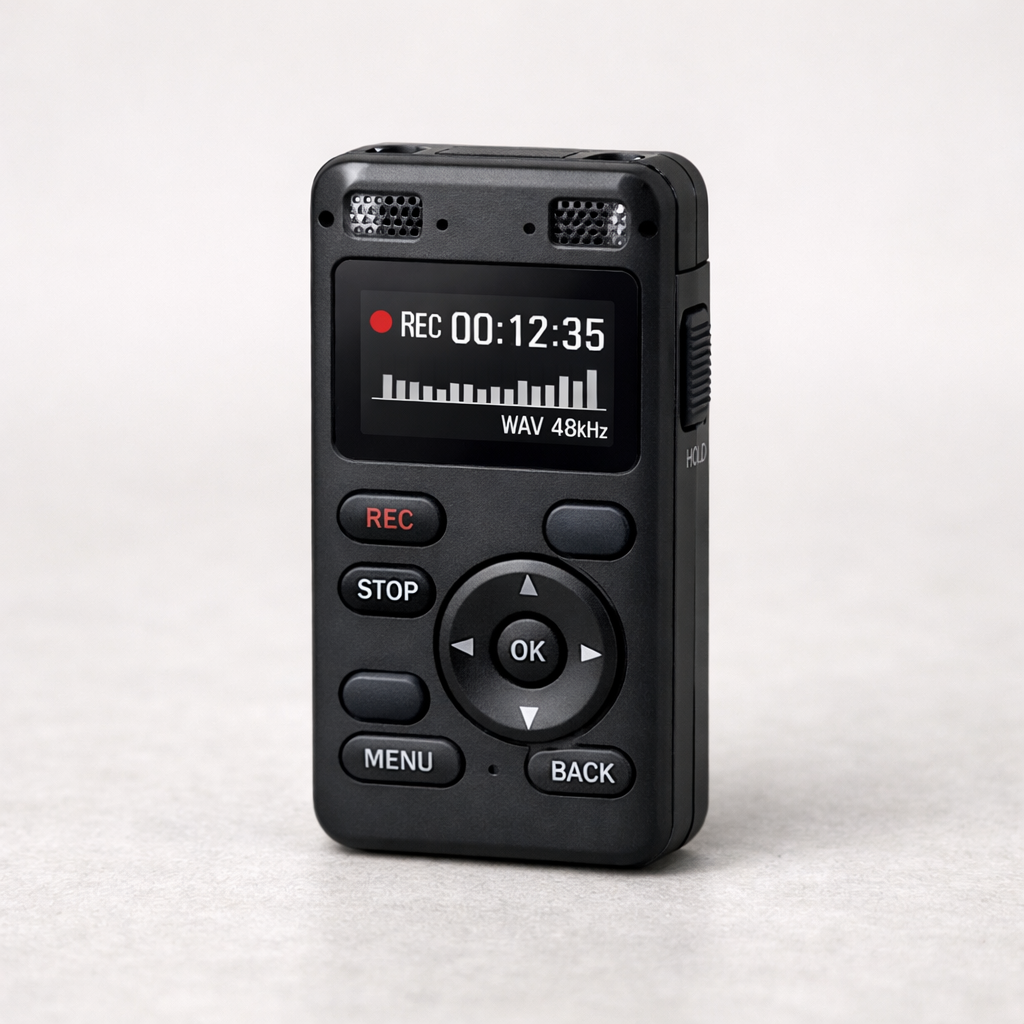
Digital voice recorders generally offer consistent file formats (WAV/PCM or high bitrate MP3), durable storage, and built-in features for locking files. A voice activated recorder saves storage and may capture only relevant speech, but it risks cutting short contextual sounds or failing to record low-volume speech. Smartphones are ubiquitous and can produce high-quality files, but app-based recordings may complicate chain-of-custody because of cloud sync and app updates. For inventory browsing and model comparisons in each category, follow your shopping checklist while reviewing store specifications Browse Voice Recorders
Pros and cons by feature
- File format and bitrate: Lossless or high-bitrate formats preserve more detail for forensic analysis; compressed formats save space but reduce forensic value.
- Metadata and timestamping: Devices that write reliable timestamps and allow export of metadata simplify authenticity proofs.
- Physical security: Tamper-evident cases, write-protect switches, and removable storage speed forensic preservation.
- Battery and redundancy: Dual-power options and automatic redundancy (simultaneous local and cloud copy) reduce the chance of missing critical audio.
Real-world use cases and decision logic
Different environments impose different priorities. Homeowners documenting threats or harassment need unobtrusive devices with clear timestamps and an easy export path to a trusted backup. Small business owners collecting witness statements after an incident must prioritize chain-of-custody and contemporaneous notes that corroborate the recording. Professionals conducting interviews for compliance or HR should prefer devices that support secure file encryption and allow immediate logging of incident details.
Homeowner scenario
If a homeowner records a neighbor dispute, the primary risks are state consent laws and proving the recording has not been edited. Use a device that embeds timestamp metadata and keep a contemporaneous written log of date, time, and context. Preserve the original file on a separate storage medium to prevent accidental modification.
Small business scenario
In workplace investigations choose a recorder that can export files with checksums or hashes, and combine recordings with signed statements and time-stamped notes. Keep devices in a secure location between interviews and document every access to the file to maintain a defensible chain of custody.
Practical examples and common mistakes
Example 1: An employee uses a smartphone app to record a meeting. The device automatically uploaded recordings to a personal cloud account that also compresses files. At hearing, defense challenges both the chain of custody and editing potential. Avoid this by disabling automatic sync, exporting the original file immediately, and noting the device status at the time of recording.
Example 2: A homeowner uses a voice activated recorder during a heated dispute. The device failed to capture preliminary threats because it was in VOX mode with a high threshold. Common mistake: relying on voice activation without testing sensitivity. Always perform a pre-use test in the actual environment and, if possible, use continuous recording during critical interactions.
Example 3: A small business uses a digital voice recorder with removable microSD cards. After an incident, multiple people access the card without documentation, creating a gap in chain-of-custody. Best practice: limit physical access, log every transfer, and create a verified copy with a checksum before sharing.
Legal and ethical considerations (US and EU)
Legal frameworks vary. In the United States, many states permit recording with the consent of at least one party, but a minority require all-party consent. Federal law and state statutes can differ, and admissibility may still hinge on how the evidence was handled. In the EU, data protection rules under GDPR can apply when recordings include personal data; lawful bases for processing (consent, legitimate interests, legal claims) must be considered and documented. Practical compliance involves both consent policies and secure data handling practices such as encryption and access controls. When planning recordings for potential legal use, consult local regulations and adopt conservative procedures to reduce risk Discreet solutions
Ethical boundaries matter even if recordings are lawful. Evaluate proportionality—was recording necessary to protect a legitimate interest? Avoid surreptitious recording where less intrusive measures (witness statements, written logs) would suffice. Maintain transparency where possible and balance privacy interests with evidentiary needs.
Frequently Asked Questions
1. Is a recording made on a consumer voice recorder admissible in court? A recording can be admissible if you can establish proper foundation, authenticity, and relevance; preservation of the original file and documentation of handling are essential.
2. Should I use a voice activated recorder or continuous recording? Use continuous recording when context matters; voice activation is acceptable for long-duration passive monitoring but test sensitivity to avoid missed speech and document settings used.
3. How do I prove a recording hasn't been tampered with? Create a verified copy immediately and compute a checksum or hash. Retain the original device and note chain-of-custody steps; forensic experts can analyze file headers and waveform integrity.
4. Do I need consent to record conversations? Consent requirements depend on jurisdiction. Some states require all-party consent; others permit single-party consent. For EU contexts, data protection rules may apply. When in doubt, secure express consent or consult counsel.
5. Can smartphone recordings be used like dedicated recorders? Yes, but smartphone apps and cloud sync create additional points of vulnerability. Disable automatic upload, export original files promptly, and document the device state to strengthen admissibility.
Educational closing
Selecting the right voice recorder for admissible evidence is a balance of technical features, operational discipline, and legal awareness. Buyers should prioritize device capabilities that preserve fidelity and metadata, adopt strict handling and logging procedures, and tailor choices to the scenario—home, small business, or professional use. Recording without preparation creates avoidable risks; structured decision-making and conservative data handling protect both evidentiary value and privacy. For model comparisons and practical procurement advice aligned to these priorities, consult product specifications and checklists before purchase