
Artigo: Voice Recorders for Evidence: How Background Noise Ruins Recordings at Home and Small Business
Voice Recorders for Evidence: How Background Noise Ruins Recordings at Home and Small Business
When homeowners or small business owners rely on voice recorders to capture evidence, background noise can obliterate clarity and turn potentially decisive recordings into inadmissible, ambiguous files. This article explains exactly how ambient sounds interfere with evidence-quality recordings, the legal and compliance boundaries to watch, and practical selection and operational choices that reduce risk Read the complete Voice Recorders guide
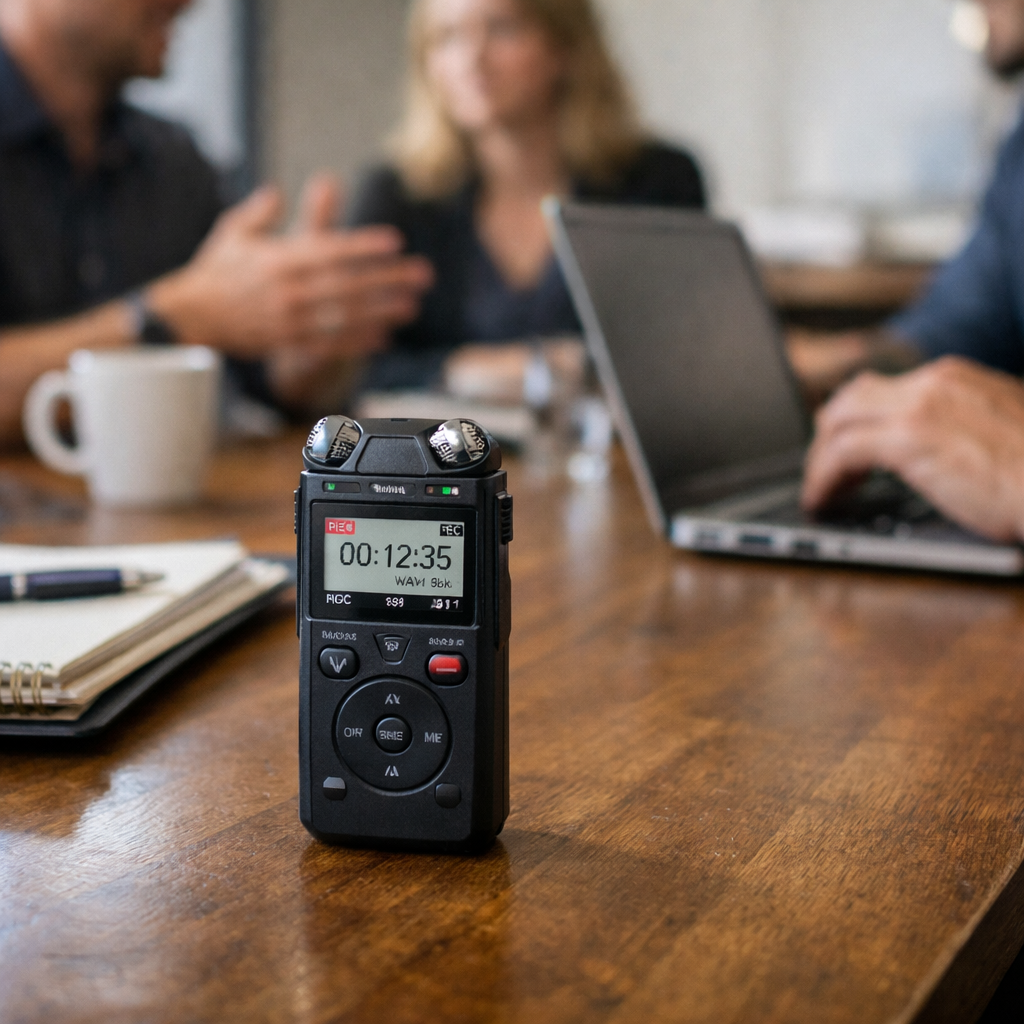
How background noise affects voice recorders
Signal-to-noise ratio (SNR) is the technical concept most relevant to why background noise ruins recordings. A recording from a voice recorder is useful when the target speech exceeds ambient noise by a margin that allows human listeners—or automated forensic tools—to distinguish words reliably. Low SNR from traffic, HVAC hum, crowded rooms, or overlapping speakers increases transcription errors and introduces artifacts during noise reduction that can alter perceived speech. A poorly placed voice recorder or an inexpensive digital voice recorder with weak preamplification will lower effective SNR and often apply compression or automatic gain control (AGC) that masks quiet words and amplifies noise.
Comparison of noise-mitigation techniques for recordings
Different mitigation approaches carry distinct pros and cons depending on context. Below are primary categories and a structured comparison.
Physical placement and directional microphones
- Pros: Immediate SNR improvement by reducing distance to source; passive and reliable.
- Cons: Limited range; requires access and sometimes consent to place devices near speakers.
Hardware filtering and microphone type
- Omnidirectional mics capture all ambient sound—better for group capture but worse for isolating a single speaker.
- Directional (cardioid or shotgun) mics reject off-axis noise but demand precise aiming and may pick up handling noise.
Recording settings and device features
- High bit depth and sample rate preserve detail for forensic processing but increase file size.
- Manual gain control prevents AGC pumping; voice activated recorder features can miss low-volume speech or fragment evidence when triggers drop out.
Post-processing and forensic enhancement
- Pros: Advanced tools (spectral subtraction, adaptive filtering) can clarify recordings after capture.
- Cons: Processing can introduce artifacts, and excessive editing raises chain-of-custody and admissibility questions in legal contexts.
Choosing voice recorders to minimize background noise: buyer guide
Selecting an appropriate device depends on use-case, legal constraints, and operational realities. Buyers should weigh technical specifications against scenarios they will face. For small business owners monitoring meetings, a digital voice recorder with directional microphones and manual gain control may be ideal. Homeowners collecting evidence in domestic disputes should consider devices with high SNR, external mic input, and discrete placement options. Avoid over-reliance on voice activated recorder modes when continuity of recording is critical; they save power and space but risk losing contextual audio.
Key evaluation criteria:
- SNR rating and microphone quality: Look for manufacturer SNR figures and choose devices with noise-rejection designs.
- Manual versus automatic gain control: Manual gain prevents pumping and distortion in variable-noise environments.
- External microphone compatibility: Support for lapel mics or directional shotgun attachments extends utility.
- File format and bit depth: Uncompressed or lossless formats preserve detail for later analysis.
- Battery life and storage: Continuous recording demands both; voice activated recorder modes may be acceptable for long-term monitoring if false negatives are tolerable.
When you need to compare models and accessories for specific tasks such as interviews, confrontation recording, or long-duration surveillance, consult product collections designed for field recording and evidentiary capture Browse Voice Recorders
Real-world scenarios and common mistakes
Below are concrete scenarios illustrating how background noise undermines evidence, with decision logic for operators.
Scenario A: Confrontation recorded in a busy retail store
Problem: Overlapping customer conversations and PA announcements reduce clarity. Mistake: Placing a portable voice recorder on a checkout counter with omnidirectional mic. Better approach: Use a directional microphone aimed at the subjects or position multiple recorders close to each party to create redundancy. If only one device is available, prioritize proximity and manual gain to avoid AGC artifacts.
Scenario B: Domestic incident captured on a phone-held digital voice recorder
Problem: HVAC noise and kitchen appliances create low-frequency rumble; a voice activated recorder repeatedly stops and restarts. Mistake: Relying on VAD (voice activity detection) which fragments the timeline. Better approach: Continuous recording at higher bit depth, followed by selective post-processing to remove hum while preserving timing and context for evidence.
Scenario C: Small business meeting with confidential content
Problem: Indistinct statements due to multi-directional seating and soft speech. Mistake: Using a built-in laptop microphone or low-quality voice recorder placed centrally. Better approach: Place several discreet recorders on the table near participants or use boundary microphones that balance group capture with improved SNR.
Common operational mistakes across scenarios include failure to document device settings, not testing placement before important events, overwriting original files during editing, and neglecting to record metadata (time, device ID) that supports chain of custody. These errors reduce evidentiary weight even when audio content is intelligible.
Legal and ethical considerations (US & EU)
Recording laws and admissibility standards differ across jurisdictions. In many US states, single-party consent allows a homeowner or business owner to record conversations they are part of; other states require two-party consent. In the EU, data protection rules like GDPR add privacy obligations when recordings capture personal data of others. Operators must consider both criminal evidence rules and privacy law: obtain consent where required, limit retention to what is necessary for the purpose, store files securely, and document handling actions that preserve integrity Discreet solutions
From an admissibility perspective, courts evaluate authenticity and reliability. Background noise that forces aggressive post-processing may be challenged as altering content. Conservatively, retain original, unprocessed files, maintain logs of any processing steps, and avoid irreversible edits. For recordings intended for law enforcement or court use, coordinate with counsel or investigators to ensure compliance with chain-of-custody and disclosure obligations.
Frequently Asked Questions
Q: Can noise reduction software reliably restore unintelligible recordings?
A: Software can often improve clarity, but heavy processing introduces artifacts and may not recover lost information; original files should always be preserved.
Q: Should I use voice activated recorder mode for evidence collection?
A: Only when continuous recording is impractical; VAD risks dropping low-volume speech and breaking context, which undermines evidentiary value.
Q: Is it legal to record conversations in a small business?
A: It depends on jurisdiction and whether the recorder is a participant; check local consent statutes and privacy rules before recording.
Q: Which microphone type reduces background noise most effectively?
A: Directional microphones (cardioid/shotgun) and close-proximity lavalier mics generally outperform omnidirectional mics at rejecting ambient noise.
Q: How should I store and label recordings for potential legal use?
A: Keep original unedited files, use a read-only archive, record metadata (time, device, location), and maintain a handling log documenting any transfers or processing.
Educational closing
Background noise does more than make recordings unpleasant—it changes whether a voice recorder can serve as reliable evidence. Technical choices (microphone type, SNR, gain control), operational practices (placement, continuous capture, documentation), and legal awareness (consent, retention, chain of custody) all determine whether a captured file withstands scrutiny. By comparing mitigation techniques, avoiding common mistakes, and selecting devices with appropriate features, homeowners and small businesses can reduce the risk that ambient sounds will destroy crucial audio evidence.