Mini Cameras for Temporary Monitoring in Homes and Small Businesses
Choosing mini cameras for temporary monitoring requires balancing size, evidence quality, legal boundaries, and concealment methods. Homeowners, landlords conducting short-term inspections, and small business owners who need short-duration surveillance should understand how mini cameras differ from standard security systems, what evidence is admissible, and which devices meet a temporary monitoring brief without creating compliance problems.
How mini cameras fit temporary monitoring: scenarios and decision logic
Mini cameras are designed for discrete, time-limited observation rather than continuous, long-term surveillance. Typical temporary monitoring scenarios include documenting short-term theft or vandalism, remote checks of a property during a repair project, verifying contractor attendance, or monitoring a short-term rental between guests. In each scenario the choice of device and deployment method depends on goals: do you need high-resolution evidence for identification, continuous capture for hours, or motion-triggered bursts to conserve power? Think in terms of scope, duration, and the minimum quality needed to meet that scope.
When deciding whether a mini camera is the right tool, map the scenario to three core constraints: duration (hours to weeks), visibility (visible deterrent versus fully discreet), and legal risk (consent and expectation of privacy). That decision logic helps rule out devices that are either overkill or legally hazardous. For instance, an always-on 4K mini camera with live streaming is unnecessary for a 72-hour contractor audit and may increase legal exposure.
Comparing mini cameras for short-term use
Not all mini cameras are built the same. Compare them across these categories: power and runtime, recording format and storage, image quality and low-light performance, trigger type (continuous vs. motion), concealment form factor, and connectivity (local only versus cloud). Below is a structured comparison framework to evaluate models against temporary monitoring needs.
Power and runtime
- Battery-operated units: Simple to install and remove; choose larger batteries or replaceable cells for monitoring beyond a few days.
- Hardwired or USB-powered: Suitable when mains access is available; riskier if you need covert placement because wiring can be traced.
- Solar-augmented systems: Useful outdoors but add complexity and are weather-dependent.
Recording method and data security
- Local storage (microSD): Reduces network exposure, useful if chain-of-custody requires physical media recovery; ensure automatic overwrite settings are understood.
- Cloud storage: Offers remote access and redundancy but introduces data residency and privacy considerations.
- Encrypted files and secure access: Prefer devices that support onboard encryption and strong authentication to protect footage during the temporary monitoring window.
Form factor and concealment
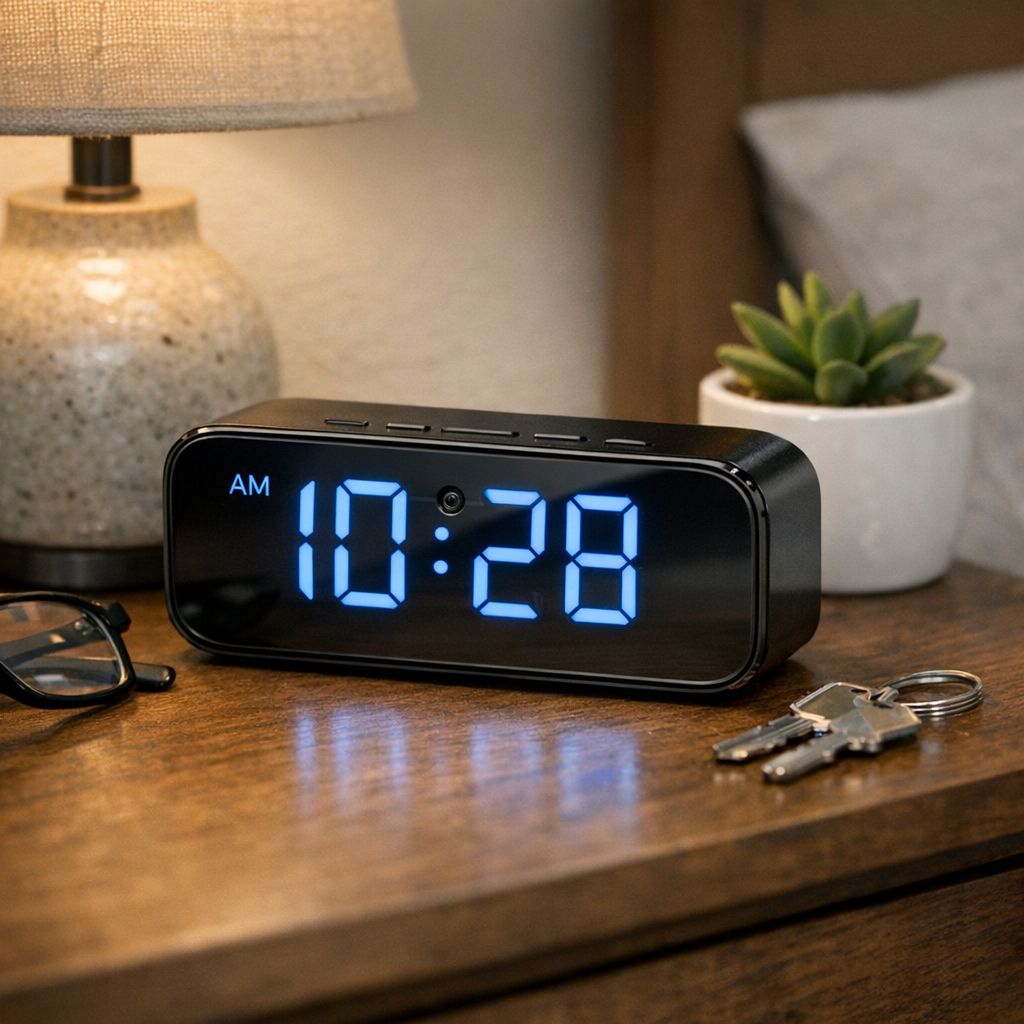
Form factor affects both detection risk and admissibility. Discreet cameras built into clocks, USB chargers, or smoke-detector housings can be effective for short-duration observation. However, overly deceptive concealments increase ethical and legal risk when used in areas with a reasonable expectation of privacy.
If you want to review available form factors across professional-grade devices, start by reviewing the category options Browse Mini Cameras. For deeper technical context on image capture and concealment ethics, consult the pillar resource on discreet recording best practices Read the complete Mini Cameras guide .
Buyer criteria for mini cameras used temporarily
Use the following checklist when selecting a mini camera for temporary monitoring: required runtime, video resolution, night capability, trigger reliability, data retrieval method, concealment suitability, and legal compatibility with the monitoring environment. Rank these criteria by mission-critical importance to avoid buying an ill-suited model.
Key specifications to prioritize
- Resolution and frame rate: 1080p at 30 fps is typically sufficient for identification at short distances; choose 2K or 4K only if you need to zoom for facial or plate recognition.
- Low-light/IR performance: If monitoring at night is necessary, confirm effective range for IR or choose a low-light sensor optimized for color in dim conditions.
- Trigger accuracy: Motion false positives can fill storage; look for devices with adjustable sensitivity and human-shape detection if available.
- Data export options: Prefer devices where you can export original files without altering metadata; this preserves evidentiary value.
Practical deployment examples and common mistakes
Example 1 — Short-term rental damage check: A property manager wants 72-hour monitoring after a pattern of damage. Best practice is to use a visible small security camera focused on entrances only, record locally to a microSD card, notify guests per local law if required, and retrieve footage immediately after the period ends. A common mistake is placing concealed cameras inside bathrooms or bedrooms, which creates legal exposure and inadmissible evidence.
Example 2 — Contractor attendance verification: For verifying presence during a single-day repair, a battery-powered mini camera in a visible location near work areas provides deterrence and a time-stamped record. Avoid concealed cameras that capture audio if contractors are in jurisdictions with strict consent laws.
Example 3 — Investigating intermittent theft: If items disappear intermittently, use a motion-triggered mini camera with short pre-buffer capability to capture context. A typical error is using a low-resolution device that cannot identify persons from a distance; instead, move the camera closer or use a higher-resolution model for identification.
Legal and ethical considerations (EU and US overview)
Legal frameworks differ between the EU and US, but both prioritize reasonable expectation of privacy and informed consent in many contexts. In the EU, the General Data Protection Regulation (GDPR) can apply when footage identifies a person and data controllers must justify processing, implement minimization, and ensure secure storage. In the US, federal law is more limited; state laws on audio recording and workplace surveillance vary widely. Always avoid placing mini cameras in private spaces such as bathrooms, changing rooms, or areas where occupants expect privacy.
Ethically, balance the need for evidence against dignity and confidentiality. Use visible devices when deterrence is acceptable and consider signage or post-event notification where required. If you retain footage, establish clear retention limits and secure deletion procedures when the temporary monitoring purpose has concluded. For operational guidance on compliance and technical recording practices, review related resources and industry recommendations Discreet solutions.
Frequently Asked Questions
Q: Are mini cameras legal for short-term monitoring in rental properties?
A: Legality depends on local laws and the specific location within the property; generally avoid placing cameras in private areas and disclose monitoring where law requires or where tenants have a reasonable expectation of privacy.
Q: Can footage from a mini camera be used as evidence in court?
A: Footage can be admissible if collected lawfully, with intact metadata and chain-of-custody; avoid methods that alter timestamps or audio without proper authorization.
Q: Should I choose motion-activated or continuous recording for temporary monitoring?
A: Choose motion-activated for longer runtime and storage efficiency; select continuous recording when uninterrupted context is essential and power/storage limitations are manageable.
Q: Is audio recording allowed when using mini cameras for temporary monitoring?
A: Audio laws vary; in many US states, recording audio without consent is restricted. In the EU, audio adds complexity under data protection rules. When in doubt, omit audio or obtain explicit consent.
Q: How long should I keep footage after temporary monitoring ends?
A: Retain only as long as necessary to achieve the monitoring purpose—commonly days to a few weeks—and then securely delete or overwrite recordings, documenting the deletion where appropriate.
Educational closing
Selecting mini cameras for temporary monitoring is a decision that blends technical trade-offs with legal and ethical boundaries. Prioritize clarity on mission objectives, map those to runtime and resolution requirements, and choose concealment and storage options that limit privacy impact while preserving evidentiary value. Where applicable, consult local regulations and established best practices to reduce risk, and use the selection criteria above to make measured, defensible choices for short-term surveillance projects.