Video Surveillance Camera Placement Mistakes for Homes & Small Businesses
Effective video surveillance depends on thoughtful camera placement; mistakes made during planning and installation are the most common cause of reduced coverage and poor evidence quality for both residential and commercial systems. Early decisions about angles, mounting height, field of view and legal boundaries determine whether footage is useful for incident response, insurance claims, or regulatory compliance. This buyer-focused guide explains placement errors, compares strategies for different environments, and gives clear decision logic for homeowners and small-business operators.
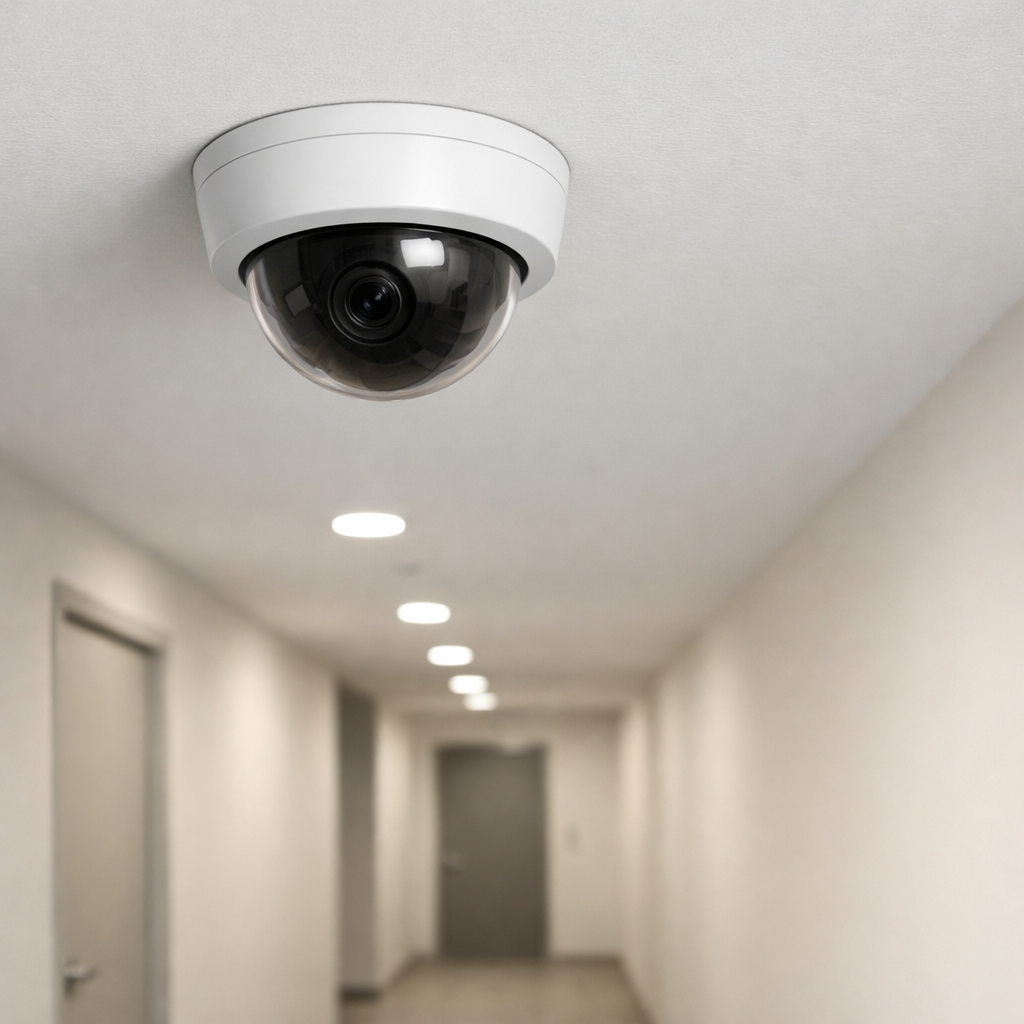
Common video surveillance camera placement mistakes
Poor placement often produces blind spots, unusable images, or privacy violations. The most frequent mistakes are predictable: cameras too high or low for identification, pointing toward glare sources, mounted where routine activity blocks lines of sight, or choosing the wrong camera type for the task. Avoid these by inspecting sightlines at multiple times of day and considering both identification distance and contextual awareness. Small adjustments in angle or lens selection can change an unusable frame into reliable evidence.
Blind spots and incorrect fields of view
Assuming a single camera covers an area is common. A wide-angle lens may capture a large scene but make distant subjects indecipherable. Conversely, a narrow lens centered on a doorway can miss approaching people. Map high-risk zones and coverage overlap: use overlapping views for critical approaches rather than trusting one long-range camera. For doorways and cash registers prioritize identification range over breadth.
Mounting height and angle errors
Mounting cameras at inconsistent heights creates inconsistent footage. A head-on angle from 8–10 feet often balances identification and context for entrances, while parking-area cameras may require lower mounts to reduce horizon clutter. Ceiling-mounted domes can limit tilt range and create occlusion from hanging signs or light fixtures—test actual tilt and pan range before finalizing a mount.
Lighting and exposure misjudgments
Placing a camera facing direct sunlight, reflective glass, or bright store signage leads to washed-out or silhouette images. Night-time requirements change this: rely on cameras with appropriate IR or low-light performance for dark alleys and loading docks. Always verify image quality in expected lighting cycles—dawn, dusk, and artificial lighting conditions vary.
Video surveillance evaluation: comparing placement strategies by use case
Choosing a placement strategy requires comparing priorities: identification, monitoring, deterrence, or license-plate capture. For homes, door and driveway identification are primary; for small retail, register and entrance coverage are vital; for warehouses, broad floor coverage with incident-triggered PTZ may be preferable. Compare fixed vs. PTZ, dome vs. bullet, and wall vs. pole mounts by the pros and cons below.
Fixed cameras vs. PTZ
- Fixed: Reliable, predictable fields, cheaper per unit, easier to secure physically. Best for entrances, corridors, and static perimeters.
- PTZ: Flexible, can inspect incidents, but rely on active control or smart tracking; may miss events when patrolling. Better for larger outdoor spaces where a single camera must serve multiple sectors.
Dome vs. bullet housings
- Dome: Low profile, vandal-resistant, good for indoor ceiling mounts where discreet monitoring is desirable. Limitations include smaller sensors in low-cost models.
- Bullet: Visible deterrent, easier aiming for long-range scenes, often have stronger housings for outdoor use. Use for driveways and perimeters where visibility is an advantage.
Buyer guide: selecting cameras, mounts and placement criteria
When evaluating products and placement options, score each candidate against four criteria: coverage accuracy (minimum identification distance), environmental suitability (IP rating, IR range), image quality in expected light, and privacy boundary risks. For most homeowners a mix of two high-resolution entry cameras and a couple of broad-angle exterior cameras works. Small businesses often need an additional camera focused on point-of-sale and one for rear access. Consider cabling, power availability, and concealment to reduce tampering risk.
Match camera selection to the expected identification distance: for license plates or facial features choose higher-resolution sensors and narrower lenses; for general motion detection a wider lens on a moderate sensor is acceptable. If the location requires a visible deterrent combine a conspicuous bullet camera with a discreet interior dome to cover theft paths.
Include maintenance planning in purchasing: angled mounts collect dirt and water, and poorly placed cameras require frequent adjustment. Procurement criteria should include warranty, mounting accessories, and availability of compatible mounts or pole adapters. For product comparison and category options refer to the surveillance cameras collection to align hardware with placement needs Browse Video Surveillance.
Practical examples and common mistakes
Use-case: a suburban driveway. Mistake: mounting the camera low on a pole to view the street; result: license plates at an angle and cars blocking the view. Better: mount higher with a narrow lens angled to the expected vehicle approach, ensuring plate-level capture at the identification distance.
Use-case: a small retail shop. Mistake: one camera above the register pointing straight down—faces are hidden under hoods. Better: use a tilted ceiling dome covering the till and an additional side-facing camera at head height to capture angles that identify individuals.
Use-case: multi-tenant building lobby. Mistake: cameras aimed across a shared corridor that record tenants’ private entrances, risking privacy complaints. Better: target cameras to shared areas and entrances, ensuring doorways within private units are not recorded. Document sightlines and share policies with tenants to reduce disputes. For installation guidance and broader system planning see the detailed pillar guide on video surveillance strategy Read the complete Video Surveillance guide .
Video surveillance legal and ethical considerations
Placement choices carry legal and compliance risks in both the US and EU. Recording private spaces—bathrooms, changing rooms, or inside apartments—can violate privacy laws and lead to civil penalties. In the US, federal law rarely prohibits private recordings in public spaces, but state laws vary on audio capture and expectation of privacy. In the EU, GDPR introduces data protection obligations: footage that can identify a person is personal data and requires legal basis for processing, retention limits, and data subject rights. This is high-level guidance; consult counsel for specific compliance plans.
Ethically, minimize recording of non-relevant private areas and inform visitors or customers with clear signage where surveillance occurs. Implement retention policies to delete footage beyond legitimate investigative periods and restrict access to recorded data. Keep an audit log of who accesses footage and why. Where audio is unnecessary for incident detection, disable it to reduce legal complexity.
For businesses assessing regulatory risk alongside hardware selection, balance coverage needs against privacy preservation: mask or blur neighboring properties’ windows and avoid capturing adjacent private yards. These operational choices reduce complaints and litigation exposure. For deeper product-level comparisons that tie into policy choices, review the secondary pillar materials on related camera types Discreet solutions.
Frequently Asked Questions
How high should I mount exterior cameras? Mount exterior cameras 8–12 feet where possible to balance tamper resistance and identification; adjust angle for clear face capture without extreme perspective distortion.
Can one camera cover a storefront? One camera can cover a storefront for general monitoring, but point-of-sale and entrance identification typically require additional focused cameras for reliable evidence.
Do dome cameras reduce glare? Domes are less prone to vandalism and can hide lens direction, but glare and exposure depend on sensor quality and placement relative to light sources rather than the housing alone.
What retention period is reasonable for recorded footage? Retention should match the purpose: 7–30 days is common for general monitoring; retain longer only for incident investigations and in compliance with privacy law.
Are wireless cameras less secure? Wireless cameras can be secure if properly configured with strong passwords, firmware updates, and network segmentation; however, wired connections reduce risks of interference and power loss.
Thoughtful placement minimizes the need for expensive hardware upgrades and reduces legal exposure while improving the value of captured footage. Approach installation as a systems decision: evaluate sightlines, lighting, mounting, maintenance, and policy together to ensure cameras serve operational needs.
Choosing the right combination of cameras, mounts and retention practices is a practical exercise in risk management. Use the placement principles here to score options, validate with on-site tests at different times of day, and update plans after any layout changes. This will help you achieve reliable coverage without overreaching into unnecessary privacy invasion.