Voice Recorders for Legal Compliance: Why Audio Quality Matters More Than Storage Size
Voice recorders play a decisive role when recordings are used as legal evidence or for compliance documentation; prioritizing audio quality over raw storage capacity is essential to preserve clarity, speaker identification, and admissibility.
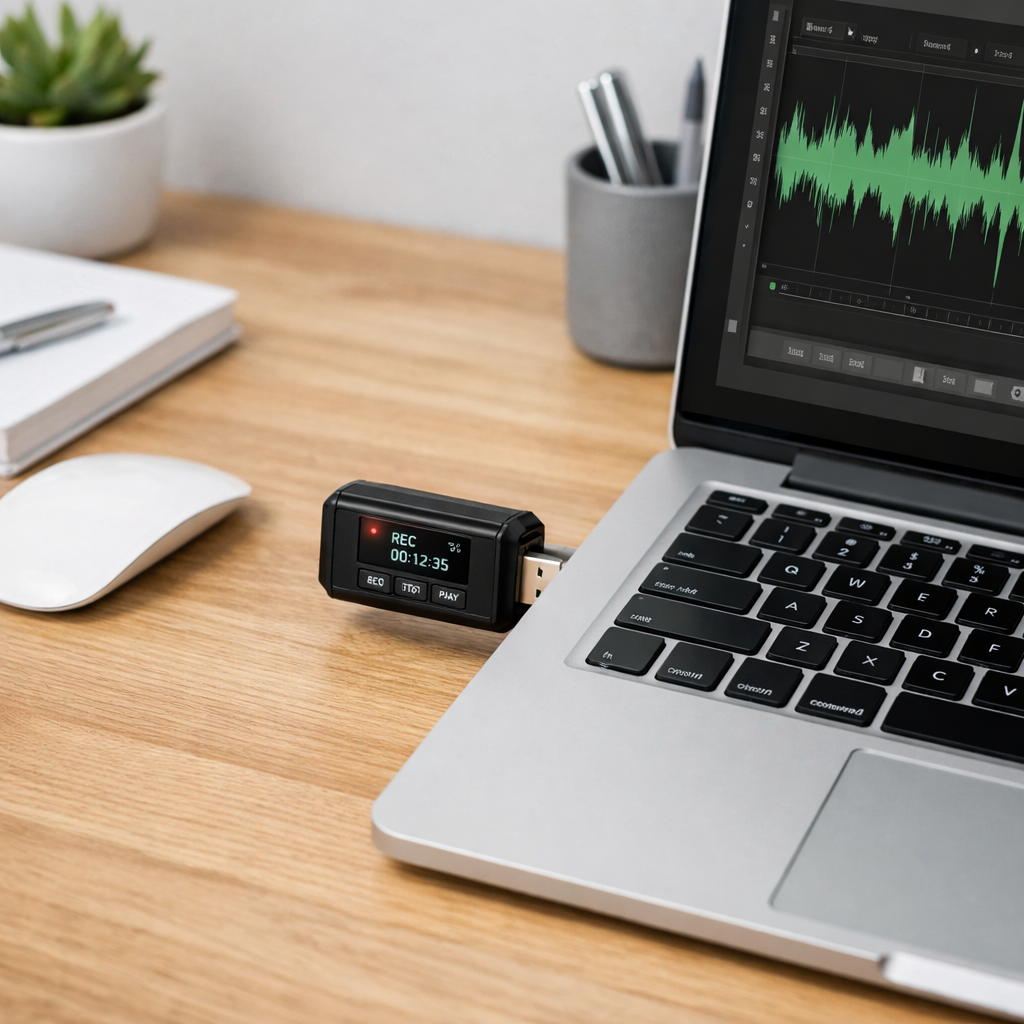
Why Audio Quality in Voice Recorders Determines Legal Value
In legal contexts, the probative value of a recording depends less on how many hours a device can store and more on whether the captured audio reliably communicates what occurred. Poor audio quality undermines transcription accuracy, increases the risk of misidentifying speakers, and invites admissibility challenges. Courts and investigators assess recordings for authenticity, intelligibility, and potential tampering; a high-fidelity capture supports chain-of-custody and forensic analysis.
Technical attributes that affect legal value include sampling rate, bit depth, bit rate, microphone design, and whether the recorder applies lossy compression. For example, a high-quality digital voice recorder capturing at 48 kHz/24-bit produces a cleaner waveform that survives forensic enhancement better than heavily compressed MP3 at low bitrates. Likewise, voice activated recorder modes can truncate speech or omit low-volume dialogue, which can be disastrous in contested investigations.
Decisions about device selection and recording settings should therefore start from intended use: courtroom testimony, HR investigations, compliance audits, or private dispute resolution. Consider each scenario’s tolerance for background noise, the necessity for speaker identification, and chain-of-custody requirements before trading fidelity for extended recording time. For device comparisons and deeper technical context, consult our detailed pillar resource. Read the complete Voice Recorders guide
Choosing Voice Recorders by Audio Quality: Criteria and Trade-offs
When evaluating voice recorders, weigh measurable audio metrics against operational needs. Key specifications to prioritize:
- Sampling rate and bit depth — Higher sampling rates (44.1–96 kHz) and greater bit depth (16–24 bit) preserve more information and reduce quantization noise; this matters for forensic enhancement.
- Bitrate and codec — Lossless formats (WAV, FLAC) retain original waveform detail; lossy codecs (MP3, AAC) save space but can remove speech frequencies and harmonic cues used in speaker comparison.
- Microphone quality and placement — Directional mics reject ambient noise; multiple-mic arrays and gain control improve intelligibility in group settings.
- Recording mode — Continuous recording ensures completeness; voice activated recorder functions can miss low-volume or overlapping speech.
- Timestamping and metadata — Embedded, tamper-resistant timestamps and secure metadata support chain-of-custody documentation.
- Encryption and file integrity — On-device encryption and checksums deter tampering and support admissibility in jurisdictions that require evidence integrity.
Trade-offs are inevitable. Devices optimized for maximal storage use aggressive compression or low sampling rates; these choices reduce file size but may undermine the recording’s evidentiary quality. Conversely, professional-grade recorders produce larger files but preserve forensic detail. The right balance depends on whether recordings serve internal documentation or will face adversarial scrutiny. For businesses comparing available models by category and price, view our curated selection. Browse Voice Recorders
Minimum Technical Specs by Use Case
Homeowner: Neighborhood Disputes and Noise Complaints
Minimum recommended settings: 44.1 kHz sampling, 16-bit depth, uncompressed WAV if possible. A compact digital voice recorder with a directional microphone reduces ambient interference. Prioritize clarity over uninterrupted runtime; compress backups if needed for long-term archiving.
Small Business: Meetings, HR Interviews, and Compliance
Minimum recommended settings: 48 kHz/24-bit if available, lossless capture, reliable timestamping, and encrypted storage. For HR investigations, continuous recording and clear chain-of-custody logs are critical. Avoid voice activated recorder modes for formal interviews to prevent gaps.
Professionals: Attorneys, Investigators, and Media
Minimum recommended settings: 48–96 kHz sampling and 24-bit depth, multi-channel capture, and lossless formats. Use devices that support metadata export, tamper-evident seals, and secure transfer protocols. Equipment that supports high-quality external microphones is preferable for contested evidence.
Practical Examples and Common Mistakes
Example 1 — An HR investigator records a workplace interview on the lowest-quality mode to capture a full day. The file is full of compression artifacts; several crucial utterances are unintelligible. The mistake: prioritizing storage and duration over capture clarity. The correct approach: schedule shorter sessions with high-quality settings and rotate recording devices or offload files promptly.
Example 2 — A homeowner uses a voice activated recorder to document a neighbor’s alleged threats. The device fails to trigger on soft-spoken threats and records only fragments. The mistake: assuming activation will catch all relevant audio. The correct approach: continuous recording with strategic placement and directional microphones, then trim nonessential portions for storage.
Example 3 — A small business records customer complaints on a phone line using lossy compression and retains files for an indeterminate period without encryption. A data breach exposes recordings containing personal data. The mistake: neglecting data protection and retention policy. The correct approach: enforce minimum quality for evidence use, encrypt stored files, adopt retention schedules, and document deletion processes.
Common mistakes summarized: choosing low-bitrate modes to maximize runtime, over-reliance on voice activation, failing to log chain-of-custody, neglecting secure storage and encryption, and not syncing device clocks to a reliable time source. Each error increases legal risk by diminishing credibility or violating privacy laws.
Legal and Ethical Considerations (US and EU High-Level)
Legal permissibility of recordings varies. In many US states one-party consent suffices, allowing a participant to record a conversation they are in; other states require all-party consent. In the EU, GDPR frames voice data as personal data: recording, processing, and retention must comply with lawful grounds such as legitimate interest or consent, subject to minimization and purpose limitation. Always verify jurisdictional rules before recording.
Admissibility in court is not automatic; judges assess authentication (is the recording what it purports to be), chain-of-custody, and whether editing or compression undermines reliability. High-quality recordings that include unaltered metadata and robust integrity checks are more defensible. For cross-border or regulatory-sensitive matters, ensure policies address data subject rights, retention limits, and secure transfer mechanisms. Discreet solutions
Ethically, organizations should balance investigatory needs with privacy expectations. Implement written policies that communicate when and how recordings occur, limit access, and define retention and deletion procedures. For workplaces, consider advance notice and legitimate business purpose documentation; for consumer-facing interactions, state disclosure practices to comply with transparency requirements.
Frequently Asked Questions
Can low-storage settings invalidate a recording as evidence? Yes. Excessive compression or reduced sampling rates can render speech unintelligible or distort acoustic cues used in speaker identification, which can lead to challenges to a recording’s probative value.
Is a voice activated recorder reliable for legal interviews? Not reliably. Voice activation can miss low-volume speech, overlapping talk, or soft-spoken statements. Continuous, high-quality capture is preferred when evidence is anticipated.
Do I need encryption on a digital voice recorder? While not universally required by law, encryption and integrity checks reduce legal risk by protecting data from unauthorized access and demonstrating steps taken to preserve evidence.
How long should recordings be retained for compliance? Retention depends on applicable laws and internal policy. Retain only as long as necessary for the legitimate purpose, document the justification, and purge according to a defensible schedule to limit exposure under data protection regimes.
Can enhancing audio compromise admissibility? Yes. Forensic enhancement is acceptable when documented and reversible; undocumented or excessive edits that alter content can harm admissibility. Maintain original files and document every processing step.
Choosing recording equipment and settings through a legal lens requires a structured approach: identify the use case, determine the evidentiary standards likely to apply, select devices and formats that preserve forensic detail, and institute secure handling and retention policies. Voice activated recorder convenience rarely outweighs the need for reliable evidence when disputes are likely.
Final considerations: prioritize clarity, integrity, and documentation. Storage strategies should complement quality—secure transfer and selective archiving reduce costs without sacrificing admissibility. Training for staff on device operation, documentation of chain-of-custody, and alignment with jurisdictional consent rules are non-technical but indispensable components in reducing legal risk and ensuring recordings remain useful when most needed.