Article: GPS Trackers for Homeowners and Small Businesses: Location Calculation vs Data Transmission
GPS Trackers for Homeowners and Small Businesses: Location Calculation vs Data Transmission
Choosing gps trackers for a home or a small business begins with understanding two distinct technical domains: how a device calculates location and how it transmits that calculated location off the device. Early confusion between location calculation and data transmission leads to mistaken expectations about accuracy, latency, battery life, and compliance obligations — particularly when comparing gps vs gsm tracking approaches for different use cases.
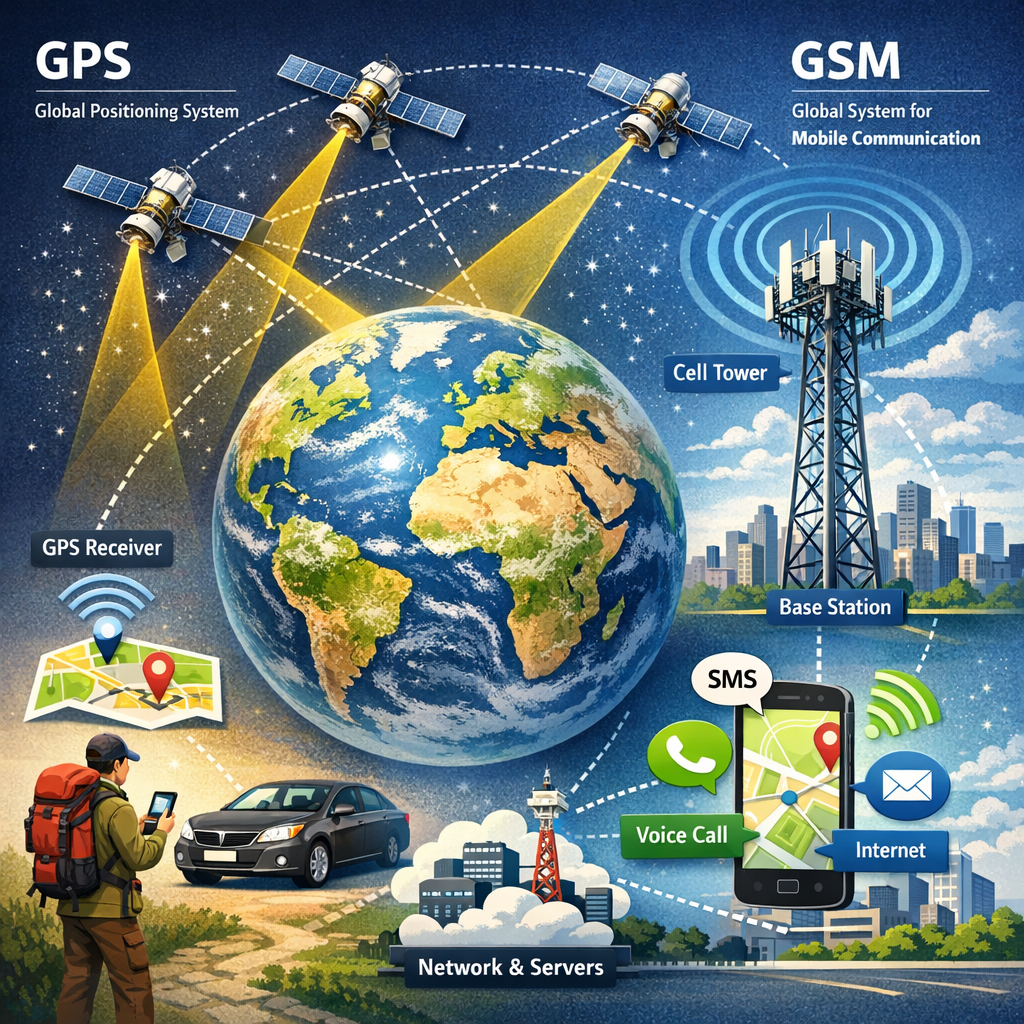
gps trackers: how location calculation works
Location calculation is the set of methods a device uses to determine geographic coordinates. The most common is GNSS (Global Navigation Satellite Systems), commonly called GPS, which calculates position by measuring the time delay from multiple satellites. Alternative on-device methods include assisted GPS (A-GPS), inertial measurement units (IMUs) such as accelerometers and gyroscopes, and local triangulation using Bluetooth or Wi‑Fi. Each method has distinct characteristics for accuracy, time-to-first-fix (TTFF), and functionality in obstructed environments.
GNSS provides absolute coordinates with typical consumer accuracy of 2–10 meters in clear sky conditions. A-GPS reduces TTFF by using networked assistance data but still relies on satellite reception for absolute fixes. IMUs and dead-reckoning can maintain relative position indoors for short periods when satellite signals are unavailable, but they drift over time. Hybrid solutions that fuse GNSS, IMU, and local beacons are common in asset trackers and some vehicle units to improve reliability.
When evaluating devices, focus on the hardware and firmware used for position calculation. Antenna quality, number of GNSS constellations supported (GPS, GLONASS, Galileo, BeiDou), and sensor fusion algorithms directly affect the real-world performance that owners will experience. For practical comparisons and implementation notes, consult the technical summaries in the product documentation and independent test reports. Read the complete GPS Trackers guide
gps trackers: data transmission methods and trade-offs
Once a location is calculated, the device must transmit that data. Transmission covers the communication technologies, protocols, frequency, and infrastructure dependencies needed to move coordinates from the device to a server, dashboard, or local receiver. Transmission options include cellular (GSM, LTE, NB-IoT), satellite, short-range radio, and local Bluetooth or Wi‑Fi transfer. The choice determines coverage footprint, operational costs, latency, and data security requirements.
GSM and other cellular methods are common because they provide broad coverage and straightforward two-way communication. Low-power wide-area networks (LPWAN) such as NB-IoT and LoRaWAN prioritize battery life and low data volume at the expense of throughput and, in some cases, latency. Satellite transmissions are essential for truly global coverage but are costlier and have higher power demands. Short-range methods rely on intermediary gateways and are suitable for campus or warehouse scenarios where local infrastructure is controlled.
Transmission selection also affects data retention policies, encryption needs, and regulatory compliance. Devices that transmit frequently or over insecure channels increase exposure to interception and may trigger stricter storage and notification obligations. Review device firmware support for encryption (TLS, DTLS) and secure key management when assessing risk for a specific deployment. Browse GPS Trackers
Comparison framework: gps vs gsm tracking in practice
When people discuss gps vs gsm tracking they are often conflating location sourcing with network transport. Use a two-axis comparison to separate concerns: axis one is location calculation (GNSS, A-GPS, IMU, beacon-based), axis two is transmission (GSM/cellular, LPWAN, satellite, local sync). Evaluating both axes clarifies trade-offs for each scenario.
- Accuracy and reliability: GNSS-based calculation is the primary determinant of raw position accuracy; GSM cell-tower triangulation offers much lower spatial resolution and depends on carrier infrastructure. Hybrid GNSS+IMU yields better continuity in urban canyons or tunnels.
- Latency: Real-time requirements push toward always-on cellular or direct radio links. If low latency is critical, prioritize transmission technology and its guaranteed delivery characteristics.
- Battery and cost: Frequent GNSS fixes and cellular connections drain batteries; LPWAN and scheduled transmissions extend life but reduce temporal resolution. Balance reporting interval against battery and data costs.
- Coverage: GSM provides wide regional coverage but not everywhere; satellite is required beyond cellular footprints.
- Security and privacy: Transmission channels determine encryption needs. Devices that store location locally and upload when in-range change compliance profiles compared with continuous remote tracking.
Scenario analysis
For a homeowner tracking a family vehicle in an urban area, GNSS for location and LTE or GSM for transmission yields precise, low-latency updates with manageable cost. For a small logistics company tracking pallets across regions, intermittent GNSS fixes with NB-IoT transmissions can dramatically reduce costs and extend battery life while providing adequate location resolution for inventory workflows.
Practical examples and common mistakes
Real-world examples highlight decisions and common errors:
- Example — Residential vehicle alerting: A homeowner used a cheap tracker that relied on cell tower location for fixes. Expectation: street-level precision. Reality: city-block accuracy only. Correct decision: choose a device with GNSS location calculation and cellular transmission for acceptable accuracy and reach.
- Example — Indoor asset tracking: A small retailer expected GPS to work reliably inside a storeroom. GPS failed in the interior. Correct approach: use beacon-based or Wi‑Fi position calculation for indoor asset tracking and local gateway transmission.
- Common mistake — assuming network implies accuracy: Believing that because a device reports location via a mobile network it must be precise. Network-based positions can be an order of magnitude less accurate than GNSS; verify the device’s stated location methodology.
- Common mistake — ignoring privacy settings and logs: Devices that log detailed location histories increase exposure if credentials are compromised or if legal requests demand records. Limit retention and enforce role-based access.
Legal & ethical considerations
When deploying gps trackers, operators must consider legal boundaries and ethical obligations. Laws differ between jurisdictions, but two high-level compliance domains are consistent: privacy/consent requirements and data security obligations.
In the United States, tracking an individual’s location without informed consent can trigger civil liability or criminal statutes depending on context (workplace surveillance, stalking laws, wiretapping statutes). Employers using trackers for fleet management should have clear written policies, documented legitimate purposes, and employee acknowledgement. Public-facing assets or rental vehicles require transparent notices and reasonable retention limits to avoid privacy claims.
In the European Union, the GDPR frames location data as personal data when it identifies or can identify a person. Controllers and processors must establish a lawful basis for processing, implement data minimization, and enable subject rights such as access and deletion. Data transmission choices (for example, using non-EU cloud endpoints) can have cross-border transfer implications and must be addressed in data protection impact assessments.
Security is integral: encrypt transmissions, limit storage duration, and maintain patching procedures for device firmware. For sensitive deployments, implement hardware-based security features such as secure elements, signed firmware updates, and certificate-based authentication. Ethical deployment goes beyond legality: disclose tracking practices, limit tracking to necessary periods, and review access logs regularly. Discreet solutions
Frequently Asked Questions
Q: How do gps trackers differ from GSM-only trackers in accuracy?
A: GPS calculation uses satellite signals and is far more precise (meters) than GSM cell-tower based methods, which give coarse location approximations often measured in hundreds of meters.
Q: Can a gps tracker transmit without a cellular subscription?
A: Yes. Some devices store locations for later download via Bluetooth or Wi‑Fi, and satellite-enabled trackers use satellite networks instead of cellular—but these options change cost, latency, and operational complexity.
Q: Is continuous transmission required for compliance?
A: Compliance depends on jurisdiction and purpose. Continuous transmission increases privacy risk; many lawful uses are compatible with periodic or on‑demand reporting combined with clear policies and consent.
Q: Which saves more battery: GNSS or GSM adjustments?
A: GNSS fixes consume notable power, while GSM transmissions add additional consumption. Optimizing reporting intervals, using assisted GNSS, or selecting LPWAN for transmissions can significantly extend battery life.
Q: How should I choose between gps and gsm tracking for a small business fleet?
A: Define requirements for accuracy, latency, coverage, and cost. For street-level tracking and real-time alerts, GNSS with cellular transmission is typical. For basic presence and periodic location logging, NB-IoT or scheduled GSM checks may suffice.
Educational closing
Distinguishing location calculation from data transmission is essential when evaluating gps trackers for homes or small businesses. Treat these as separate design axes: the former determines precision and continuity, the latter determines reach, timeliness, and exposure. Build selection criteria around your operational needs — accuracy, latency, battery life, cost, and regulatory obligations — and verify device specifications against real-world tests. Clear policies, minimal data retention, and secure transmission practices reduce legal and ethical risk while delivering the functionality owners require.