
Voice recorders for long unattended sessions: buyer's guide for homes & small businesses
Choosing voice recorders for long unattended sessions requires balancing battery life, storage strategy, activation mode, and legal constraints. This buyer's guide focuses on practical selection logic for homeowners, small business owners, and professionals who must record audio reliably while leaving the device unattended for hours or days. Early decisions about continuous versus event-based capture, file formats, and data handling determine whether a deployment is useful, lawful, and low-maintenance.
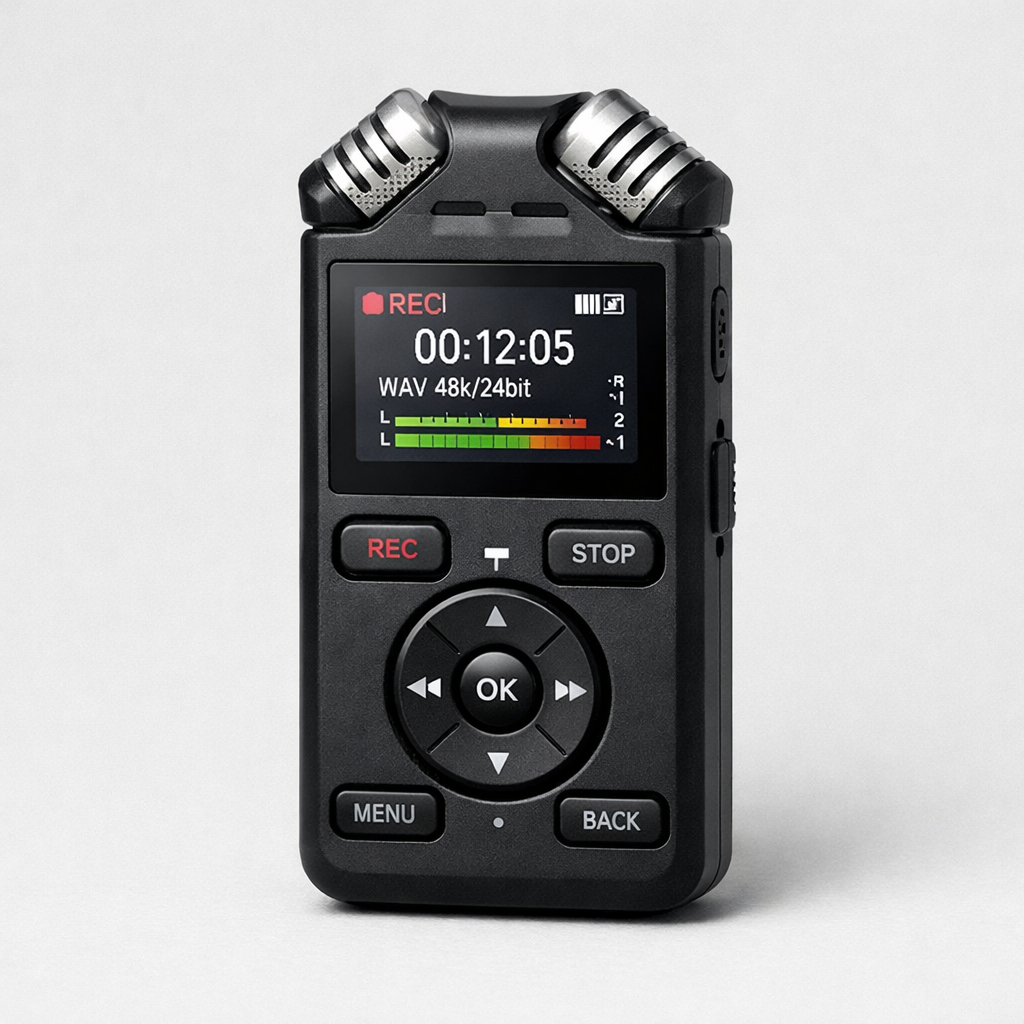
How to choose voice recorders for long unattended sessions
Start by defining the unattended session use case: scheduled interviews, overnight environmental monitoring, multi-hour meetings, or round-the-clock site logging. The precise need drives the priority between battery runtime, storage capacity, and trigger reliability. For example, overnight monitoring emphasizes low-noise floor and microphone sensitivity, while multi-day evidence collection emphasizes robust storage and tamper resistance.
When evaluating devices, compare nominal battery life against real-world duty cycles: continuous recording consumes far more power than low-power voice activation. Choose a model rated for the desired session duration with a safety margin of 20–30% to account for temperature and aging. If you plan to store files locally, calculate storage by estimating bitrate and file format: a 128 kbps MP3 consumes about 1 MB per minute, while higher-quality WAV files consume substantially more.
Look for models that offer authentication features (file stamps, encrypted storage) if retention integrity matters. Consider whether remote monitoring or tethered power options are available for long deployments; some units operate while charging from USB power supplies designed for unattended plugs. For a deeper technical reference, consult the detailed product analysis and performance benchmarking in our extended resource Read the complete Voice Recorders guide .
Key technical criteria for voice recorders
Battery and power management: Battery capacity in mAh is useful but not definitive. Review published runtime under continuous and voice-activated conditions. Check whether the recorder supports external battery packs or power-through charging; both add options for extending unattended runs.
Storage and file management
Storage type matters: internal flash with encryption is compact and secure, while microSD slots provide flexible capacity and faster offloading. For long unattended sessions, file rollover and auto-deletion rules prevent a full storage lockout. Choose a device that splits recordings into manageable segments (for example, 30–60 minute files) to reduce data loss risk if a file becomes corrupted.
Audio quality and microphone characteristics
Microphone type (omnidirectional vs. directional), signal-to-noise ratio, and preamp quality determine usable range. A small, high-sensitivity capsule with low self-noise is preferable for distant or quiet sources, whereas an onboard directional microphone suits focused monitoring. If the recorder lists a minimum detectable sound level, use that specification to estimate effective coverage in your environment.
Connectivity and data integrity: Consider encrypted internal storage or models that sign files to record chain-of-custody metadata. For unattended installations in sensitive settings, devices that write to tamper-evident containers and provide checksum capability reduce risks in later review.
Comparing recorder types: pros, cons, and ideal scenarios
Standalone digital voice recorders: Compact, power-efficient, and affordable. Pros include portability and long battery options; cons include limited I/O and sometimes non-removable batteries. Ideal for homeowners monitoring intermittent events and professionals needing discrete, easy-to-deploy units.
Voice activated recorders: Designed to record only when audio crosses a threshold, these dramatically extend battery life and storage efficiency. They can miss low-volume speech or distant sounds if sensitivity is set too high. Use voice activated recorder modes when sessions are expected to include long silent periods and when missing brief low-level events is acceptable.
Digital voice recorders with external mics or line-in capability: These are best when you need to connect to higher-quality microphones or integrate with security systems. They tend to be more expensive but deliver superior audio fidelity and greater flexibility for fixed installations in small business environments.
Integrated systems (networked or IoT audio devices): Provide remote streaming and alerts but introduce network reliability and security considerations. For unattended deployments where on-site access is limited, a networked digital voice recorder can permit real-time checks and automated backups; however, they require secure configuration and ongoing maintenance.
Practical examples and common mistakes
Example 1 — Overnight neighborhood noise log: A homeowner needs to capture intermittent disturbances across 10 nights. Best choice: a voice activated recorder with low-noise mic, microSD slot for extended storage, and a battery rated for multiple nights plus the option for USB charging. Common mistake: using continuous mode on a high-bitrate format that fills storage after a single night.
Example 2 — Small retail after-hours audio monitoring: Owner must detect break-ins without continuous remote supervision. Best choice: a discreet digital voice recorder with motion-sensor paired activation or voice activation combined with secure file stamps. Common mistake: deploying a device without tamper-evident placement or without regular file retrieval protocol, creating legal chain-of-custody issues.
Example 3 — Environmental or wildlife field recording: Researcher needs long unattended sessions in variable weather. Best choice: ruggedized recorder with external battery option and directional microphone capsule, storing compressed files to conserve space. Common mistake: not testing auto-gain or sensitivity settings before deployment, resulting in clipped peaks or inaudible distant sounds.
Operational mistakes to avoid: failing to test a full unattended run, neglecting firmware updates that patch security flaws, and assuming voice activation will capture whispered or distant speech without calibration. Routine pre-deployment checks reduce failure rates dramatically.
Legal and ethical considerations (US and EU)
Recording laws differ by jurisdiction and use case. In the United States, federal law allows recording of a conversation with at least one party's consent in many contexts, but several states require two-party (or all-party) consent. In the European Union, data protection laws like the GDPR regulate personal data processing; audio that identifies an individual is personal data and triggers obligations around lawful basis, purpose limitation, and secure storage.
High-level compliance guidance: confirm consent requirements before unattended recording in private or shared spaces; establish clear retention schedules and secure storage; anonymize or minimize captured personal data when possible. For workplace monitoring, provide transparent policies and, where required, consult legal counsel or HR guidance before deploying voice recorders in employee areas. This guidance is educational and not a substitute for formal legal advice.
Frequently Asked Questions
Q: How long will a typical consumer voice recorder run unattended? A: Typical consumer models run from 10 to 48 hours continuous on a full charge; voice-activated modes can extend that to days depending on duty cycle and sensitivity settings.
Q: Is voice activation reliable for distant or quiet sounds? A: Voice activation improves power and storage efficiency but may miss quiet or distant sounds unless sensitivity and preamp gain are adjusted; testing in the deployment environment is essential.
Q: What file format should I use for long unattended sessions? A: Use compressed formats (MP3, AAC) for long-duration logging to conserve space. Choose lossless (WAV) only when forensic-quality audio is required and you can provision sufficient storage.
Q: Can I leave a voice recorder plugged into power unattended indefinitely? A: Many recorders can operate while charging, but uninterrupted tethered power increases exposure to failure modes and power interruptions. Use surge-protected supplies and consider battery redundancy where continuous capture is critical.
Q: Where can I find models suited to extended unattended recording? A: Product collections focused on long-run and professional recorders list battery-optimized and ruggedized units; review category pages for feature filters and detailed specs Browse Voice Recorders. For in-depth comparisons and deployment checklists, review our technical pillar analysis Discreet solutions.
Educational closing
Selecting the right voice recorder for long unattended sessions begins with precise use-case definitions: expected duration, acceptable loss risk, environment, and legal boundaries. Evaluate battery and storage together, test activation modes under realistic conditions, and document handling and retention policies before deployment. When in doubt about legal limits or evidence chain requirements, seek formal counsel. For model selection and side-by-side specifications targeted at unattended recording, consult our product reviews and category filters to narrow choices responsibly . Thoughtful selection and disciplined procedures reduce operational risk and increase the reliability of long unattended audio capture.